Showing posts with label Dell. Show all posts

Friday, October 28, 2022

Longbox Junk Halloween Horror 2022 Part 15 - Ghost Stories #35

Welcome to Longbox Junk, where nobody asked me to write any of these comic reviews!

The Longbox Junk 2022 Halloween Horror party is just about over. . .but not quite yet!  There's still a couple of days left before I wrap it up and get back to Longbox Junk business as usual.  Until then, how about another spooky retro review?

So, there I was. . .on Facebook browsing through the posts provided by the fine and friendly folk of OLD GUYS WHO LIKE OLD COMICS .  And here's a free plug. . .if you have ANY love for all things comic book-related from days gone by (as in, before 1986), then join this group!  It's one of the best comic groups out there, and I'll sing their praises any old time. Plug over. 

ANYWAY. . .

There I was browsing the posts of one of my favorite Facebook groups and I saw someone had posted a spooky comic book cover.  I said to myself, "Hey! I have that one!"  And so here we are, because why not share what's INSIDE the comic too?  That's what Longbox Junk is all about!

We're heading back to 1973, folks! Let's GOOOOOOO!!

GHOST STORIES #35
Dell (1973)


COVER: Jack Sparling

THE COVER:

Jack Sparling was a Dell and Gold Key mainstay.  If you have any Dell or Gold Key comics in your collection, you've probably got some Sparling in there.  This cover isn't his best work (my personal favorite is probably Emergency #3), but it's a solid cover.  Not bad. . .I just like Sparling's painted covers better. Let's get inside!

THE STORIES:

Four original stories in this one.  That's just a nickle apiece!
Let's give each one their own turn.

FORGET-ME-NOT

SCRIPT: ?
PENCILS: Jack Sparling
INKS: Jack Sparling

The Ghost of an ancient Egyptian King shows two archaeologists where ruins they've missed are in a valley that is about to be flooded.  The Ghost also convinces the disbelieving Engineer in charge of the project to delay long enough for the treasures of the hidden temple to be found and preserved.


THE REVIEW:

Meh.  A pretty bland and forgettable story.  The ending is a little abrupt and anticlimactic.  Sparling's art is pretty good.  Like the cover, not his best work, but solid visual storytelling.  An underwhelming start to this issue.

NEXT!

THE SECOND CREW

SCRIPT: ?
PENCILS: Jack Sparling
INKS: Jack Sparling

After a U.S. Navy Captain destroys a sub on the last day of WWII just before receiving notice that the war is over, he is consumed by guilt for the death of the men he killed.  He spends his lifetime trying to make amends. . .even going so far as to move to Japan and adopt the families of the submarine crew.

When he dies and is buried at sea, his ghost joins the ghostly crew of the sub and together they bring the wrecked ship home so they may all rest in peace.


THE REVIEW:

Unfortunately, another pretty bland and forgettable story.  It's not BAD, it's just sort of. . .there.  Sparling's art is once again the high point of the story and even that seems sketchy and rushed in places.

*sigh* This isn't going well, so far.

NEXT!

DO UNTO OTHERS

SCRIPT: ?
PENCILS: Jack Sparling
INKS: Jack Sparling

When an old man named Horace is killed during a robbery in broad daylight, four witnesses to the crime give various reasons why they didn't help him when they could have.  Horace's spirit rises from the grave, determined to teach them a lesson in caring.

As the years go by, Horace's ghost helps each one of the witnesses survive a life-or-death situation, revealing himself to them so they know it was the man who they let die helping them live.  In the end, the four witnesses do indeed learn how to care.


THE REVIEW:

Yet another bland and forgettable story.  Once again, the art by Sparling is about the only saving grace. . .and once again, this isn't even his best work.  So disappointing.

I don't have high hopes for the last story, but here we go anyway.

NEXT!

YOU SEE, THERE'S THIS MONASTERY IN OREGON. . .

SCRIPT: ?
PENCILS: Jack Sparling
INKS: Jack Sparling

After Carrol's best friend, Brit is killed in a car wreck, she remembers an urban legend about a monastery in Oregon where people who are supposedly dead live.  Following a mysterious hearse, Carrol discovers the monastery and the ghost of her friend!

But as she rushed toward Brit, Carrol falls off a cliff and dies.  Now she and Brit live together at the monastery. . .forever.


THE REVIEW:

Not only is this another disappointing story, but it's also probably the worst of the bunch.  It really doesn't make much sense.  Even Sparling's art is weaker than anyplace else in the issue.  This whole story just feels rushed and sort of thrown together. Not a good end for the issue at all.

CONCLUSION

I've said it before, and I'll say it again: They can't ALL be winners.
This issue isn't a winner.  

The main problem here is the writing.  It's bland and uninteresting through the whole thing, giving the reader four stories that will be forgotten moments after reading them.  The writer of this issue is unknown, and it's hardly surprising that they didn't want to take credit for such a lackluster offering.

One would THINK that with four stories, at least ONE would be decent, but no.  And it's not that the stories are necessarily bad, it's that they're all just sort of. . .there.  

This isn't a BAD comic. . .it's just so forgettable that I can't think of anything to recommend it for beyond some pretty solid art from Jack Sparling, and even THAT isn't his best work by a long shot.

It's extremely disappointing for me writing this pretty poor review because I KNOW that it's probably the first, last, and only review that will ever be written about this issue.  This is it.  Truthfully, it makes me a little sad just thinking about it.  This issue gets ONE review in almost 50 years and it's not a great one.

I guess I'll just say it again:  They can't all be winners.

Up Next. . .

I think I can squeeze in a little bit more Halloween Horror fun before the end of the month!

Be there or be square.

Wednesday, June 15, 2022

Longbox Junk Retro Review - Four Color #942 (Tales of the Pony Express)

Welcome to Longbox Junk, the place to find more comic reviews you never asked for than you could ever ask for! Read it again. . .it DOES make sense!

Recently, I've thrown out a few reviews of comics that are the bread-and-butter bargain box fillers. . .and there WILL be more to come.  But right now, it's flea market and yard sale season here in Utah and I've been having a pretty good run of luck finding some great older comics.

And so, I got to thinking. . .

If comics from Malibu, Image, Marvel's New Universe, and the like are some of the comics you're practically guaranteed to find while Longbox Junkin' through the cheap bins at your local comic shop. . .what are some of the comics you're most likely to find at the flea market, or at an estate sale, or at an antique/junk store?  In other words, what is the "Longbox Junk" of comics found OUTSIDE of the comic shop?

Three words: Dell Four Color

Dell's Four Color comics have to be THE most common comics I've come across outside of comic shops.  The series ran from 1939 to 1962, for an astounding 1354 issues. . .the record for the most issues produced of an American comic book.  Four Color hit 1000 issues LONG before Action Comics managed to get to that milestone.  Not bad for a series that didn't have any regular characters or continuity!

Four Color isn't so much a "series" as it is a vast collection of one-shots.  Each one can be read on its own, in any order.  They cover a VERY wide range of subjects. . .heavy on licensed properties popular at the time, and Disney properties in particular.  You can find anything from westerns to detective stories, to funny animals, to adaptations of movies and novels. . .and everything in between!  

And, like I said above, the great thing about Four Color comics are that they are easy to find in the wild.  I have about FIFTY of them in my collection!  Even better than the relative ease of finding them is the rock bottom prices most of them are sold at.  I see some pretty high "values" in online price guides for Four Color comics. . .but I've never paid more than twenty bucks for one.   

What I'm trying to say is that if you're Longbox Junkin' out in the wild outside the comic shop, you WILL find Four Color comics, and you WILL be able to afford issues going back into the Golden Age of comics.  Perfect example: The issue at hand is from 1958, in decent condition, and I bought it at a flea market for FIVE BUCKS.

ANYWAY. . .

Let's strap into the Longbox Junk time machine and take a trip back to 1958, when westerns were king and comics cost a dime!  Ready? LET'S DO THIS!


FOUR COLOR #942
TALES OF THE PONY EXPRESS
DELL (1958)


COVER: Sam Savitt

THE COVER:

I'll tell you true, folks.  To ME, that cover alone is worth the five bucks I paid for this comic!  Just look at it! It's FULL of motion, action, and detail!  This stunning painting of a Pony Express rider running for his life from a band of pursuing Indians isn't just a great comic cover, it's a great piece of western art, period.  Let's get inside!

THE STORIES:

Plenty of Western action in here for your one thin dime! Two full-length comic adventures, along with two one pagers on the inside front and back covers.  You can't buy THAT for four bucks these days!

Let's check out each one in their own turn, shall we?  WE SHALL!

ALERT FOR WAR PAINT 
(Inside Front Cover)

SCRIPT: ?
PENCILS: Nicholas Firfires

Basically a short little lesson in the meaning of various Native American war paints.  It's actually pretty  interesting, but there's not much more here than an appetizer.  The whole thing is scanned below.


NEXT!


WAR PAINT

SCRIPT: Eric Friewald & Robert Schaefer
PENCILS: Nicholas Firfires

THE STORY:

Pony Express rider Craig Garrett is given the task of buying new horses for the Express, as well as being trusted with the $5000 in government gold allocated for the purpose.  Little does he know that word of the gold being held at an isolated Express station has gotten out and a band of outlaws have attacked and stolen the funds, making it look like it was an Indian attack!


Garrett isn't convinced that Indians were behind the attack, though.  He follows clues and believes he's found proof, but must keep on the trail and prove his theory before the army mobilizes against the Indians and it's full-on war!  

He and another express rider follow clues to the town of Liberty Junction, but lose the trail.  Garrett discovers that a man named Miller had been talking about the Express Station attack before it happened, and Garrett is back on the trail!  

The two Express riders head to Indian Land outside of town after hearing that Miller is a friend of the local tribe. They don't receive a warm welcome, but Garrett convinces the warriors that confront them  that he's there to prevent a war and needs to see their Chief. . .


The tribe's Chief is doubtful that a friend of the tribe like Miller would use them to hide such a crime as murder and theft, and even to try and pin the blame on the tribe.  But after overhearing Miller secretly talking to his two co-conspirators, he quickly realizes that Garrett is telling the truth.

Knowing they've been found out, Miller and his friends make their escape from the camp. Garrett, his partner, and an Indian brave set off in hot pursuit!  


After a short gun battle, the criminal gang is taken down.  At the end of it all, the gold is recovered, a war is prevented, and the Pony Express has made some new Indian friends.  All's well that ends well.


The End.

THE REVIEW:

Okay. . .not bad!  I liked that this story followed a trail just a little bit out of the ordinary, giving the reader equal parts investigation and action.  It wasn't all just rootin' tootin' shootin' like you find in a lot of these older western comics. 

 I can see that there was some actual thought and effort put into this story, which is a little surprising because if you read a lot of old westerns like I do, you KNOW that there's quite a bit of similarity across the board. 

The art was also surprisingly good for Four Color.  Normally, what you get is a fantastic cover and art inside that hopefully is at least serviceable, but usually is borderline bad.  The art here is actually pretty good.  Not great, but solid and better than expected. 

So overall a well-done story backed up by decent art.  Not bad.  I usually come into these Four Color comics with pretty low expectations, but this time I was pleasantly surprised.  Let's check out the second story and see what we get.

NEXT!

DESERT AMBUSH

SCRIPT: Eric Friewald & Robert Schaefer
PENCILS: Nicholas Firfires

THE STORY:

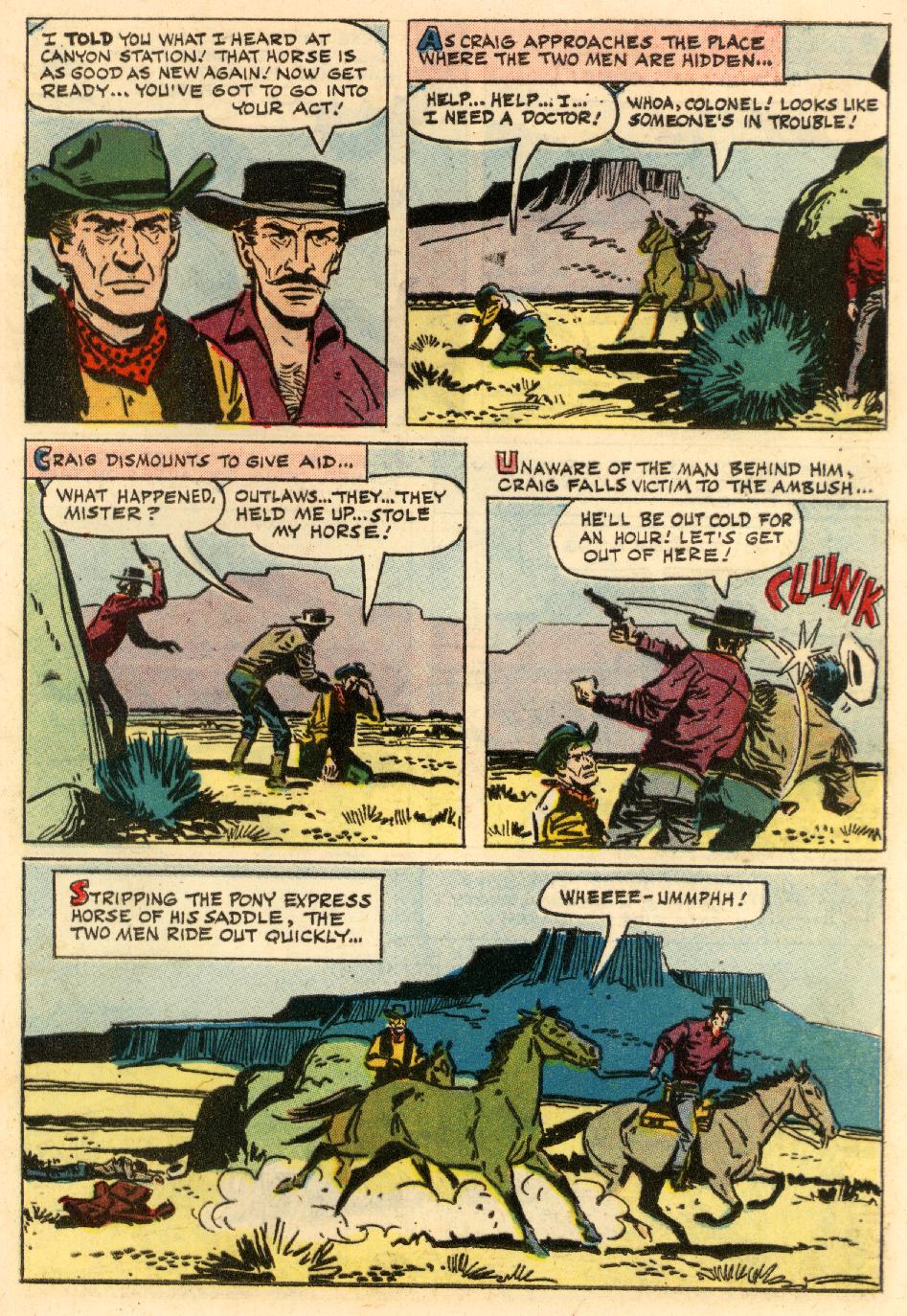
Pony Express rider Craig Garrett is tricked into an ambush by two men while riding a dangerous route across the Nevada desert.  When he wakes up from the attack, he realizes that the men didn't steal any of the mail, just Garrett's prize horse, Colonel.


After recovering from the attack for a few days at a nearby Express Station, Garrett takes a leave of absence.  He's seen that there's a big horse race taking place in Carson City in four days, and suspects that he was ambushed because of his horse's reputation for being one of the finest in the West. . .and that the culprits will be entering Colonel in the race.


Arriving in Carson City, Garrett meets a man named Len Miller, who was entered in the big race, but has to forfeit his entry fee because his horse has taken ill.  Miller offers Garrett the hospitality of his home while the Express rider tries to locate his own horse.


The next morning, before the cross country race begins, Garrett and Miller spot the two men who ambushed Garrett a few days before.  They've got Colonel, and just as Garrett thought, have him entered into the race.  Garrett confronts the men.  They deny his accusations and the sheriff is called.

Garrett proves his ownership of Colonel by giving the horse commands that he obeys.  That's enough proof for the Sheriff and the two thieves are taken away to jail.  In thanks for Miller's hospitality, Garrett lets him ride Colonel in the big race.


Riding the powerful Pony Express horse, Miller easily wins the race.  With the prize money, he can now afford an operation that his wife needs.  Garrett has his prize horse back again.  All's well that ends well.


The End.

THE REVIEW:

With the same creative team as the first story, it's no surprise that this one is pretty solid as well.  Once again, there's less focus on gunplay than one would expect from a western comic from the 1950s.  As a matter of fact, there's NO gunplay at all in this story! There's a little bit of fist fighting to be had in a couple of places, but this is definitely a story that breaks my expectations for a Golden Age western comic!  I like that.  I like it a lot!

Overall, this was a well-written little nugget of western action that steps outside the boundaries of what I normally expect.  It's backed up with some very solid art, and I found it to be a pretty enjoyable read.

Let's wrap this up!

TRAILS THAT CROSS
(Inside Back Cover)

SCRIPT: ?
PENCILS: Nicholas Firfires

Another one pager to finish this comic off like the one on the inside front cover that started the show.  Like the opener, there's not much to this little story. . .a tale of two Pony Express riders passing each other while they sleep in the saddle.  If the one inside the front cover was an appetizer, this one makes for a nice little dessert.  The whole thing is scanned below. . .


CONCLUSION

One of the things I love about doing these Longbox Junk "Retro Reviews" is knowing that I'm writing what will probably be the ONLY review of this comic that has been, or ever will be, written.  I feel that by scanning the pages and describing the contents, I'm doing a small part to add to the overall comic knowledge out there, even if nobody asked me to.  

Hopefully, I don't sound like I'm not just tooting my own horn, and some of what I've put out here in this review will be useful or informative for those interested in Golden Age western comics like this one.  

THAT SAID. . .

I found this comic to be quite a surprise.  Both of the stories focused less on gunplay and more on narrative than I expected coming in.  There's plenty of action, don't get me wrong, but that action is a different sort than I'm used to when I open up a Golden Age western comic.  

The stories seemed less like boilerplate, and more like some thought and effort had been put into them.  The artwork was also surprisingly solid for a Four Color comic.  The combination of the two gave me some timeless western action that still reads well even after 64 years!

I'm not sure how rare this comic is, but I can certainly recommend it to anyone who enjoys a good western story that steps slightly outside the often-repeated scripts that most Golden Age western comics stick to.

Up Next. . .

Back to the bargain bin!

If you've ever gone digging through a dollar box, I can practically guarantee you've seen a "Glory" comic.  So let's take a look at Image's version of Wonder Woman, shall we?  WE SHALL!

Be there or be square!

Tuesday, August 31, 2021

Longbox Junk Retro Review - The Lone Ranger #84 (1955)

Welcome to Longbox Junk, the blog that's just FULL of comic reviews nobody asked me to write!

To me, comic collecting is all about the hunt.  Finding unexpected comic book treasure in a forgotten back issue bin way down on the bottom shelf back in the corner. . .or sitting in a pile of unbagged comics with the pages flapping in the wind on a folding table at the flea market. . .or hiding in the middle of a pile of old Life Magazines in a milk crate at a little antique shop. 

Maybe it's just me, but I think the internet has sort of ruined comic collecting a little bit.  The easy access and ability to specifically pick and choose which comics you want to buy have brought a little bit too much focus on "Value" and "Grade" of comics and taken away some of the joy of discovery.

CASE IN POINT. . .

I'm a huge fan of The Lone Ranger.  Unfortunately, older Lone Ranger comics are a little hard to come by in "The Wild".  Yeah. . .I could just jump on the internet and buy whatever old Lone Ranger comic catches my eye, but where's the fun in that?  

So imagine my joy when I discovered not one, not two, but FIVE Golden Age Lone Ranger comics in decent condition sitting in a cardboard box mixed up with a bunch of battered Richie Rich and Archie comics at the local flea market about a month ago for a lousy TWO BUCKS each!

Now THAT'S the sort of find that keeps me excited for hunting comics in "The Wild" right there!

SO. . .

Since I've found these great old Lone Ranger comics, why not take a closer look at one?

Let's strap on a set of ridiculous steampunk goggles and crank up the Longbox Junk time machine for a trip back to 1955. . .when westerns were at the top of the pop culture pile and characters like The Lone Ranger cast a long shadow over the imagination of young Americans.  That's right, it's time for a Longbox Junk Retro Review!

Ready? Let's do this!

THE LONE RANGER #84
DELL (1955)


COVER: Sam Savitt

THE COVER:

Let's get this much straight. . .the cover of this comic is worth the admission no matter WHAT is inside.  I've said it before, and I'll say it again:  In my humble opinion, Dell/ Gold Key comics have some of the greatest covers in comic book history.  Unfortunately, the interior art rarely ever even comes close to matching what's on the cover.  This comic is no exception.

But that cover, though!  Now THIS is one awesome Golden Age comic rack eye-catcher!  I haven't owned this comic for long, but it's already among my top ten favorite covers in my collection.  Heck, I'd say top five.  

Just LOOK at this cover! Feast your eyes on the rich colors! This beautifully-painted piece of western art perfectly captures the motion, the spirit, the energy of The Lone Ranger and Silver.  It's just a wonderful moment of action captured in art!  I could go on, but let's get inside. . .

THE STORIES:

Never let it be said that a kid didn't get his money's worth from a Golden Age comic!  Under that awesome cover rests three full length comic stories, an illustrated text story, and a couple of one page non-fiction information pieces.  That's a nice amount of western fun for one thin dime!  Let's take a look at each story in turn. . .

THE GHOST RIDERS
SCRIPT: Paul S. Newman
PENCILS: Tom Gill

When the town of Weston is plagued by a series of robberies carried out by what seem to be glowing ghost men, the entire town is terrified except for the sheriff.  Tales of the ghostly gang reach The Lone Ranger and Tonto, who arrive in town to help the sheriff get to the bottom of the strange happenings.

During their investigation, while taking shelter from a rainstorm in a cave outside of town, the Ranger discovers the secret of the glowing robbers. . .a phosphorescent sludge that the criminals are soaking their clothing in to fool the townfolk into thinking they are spirits!

The Ranger and Tonto work with the sheriff to set up a trap, and manage to catch the bandits flat footed in the dark, where their glowing clothes make them easy targets.  Their work done, the Ranger and Tonto ride off to their next adventure.

The End.


Not a bad little story to start things off with.  Not bad at all.  I like that this short tale shows us the Lone Ranger as an investigator, solving a mystery.  It's a simple story, but it still reads well 66 years down the road, so there's something to be said for simplicity.  

The art is also surprisingly nice for a Dell comic.  I usually have a pretty low bar when if comes to Dell/Gold Key comic interior art, but the art here is actually very nicely done, with rich dark inks, plenty of detail, and with none of the sloppy coloring issues that often turn up in Golden Age comics.  It doesn't hold a candle to the fantastic painted cover, of course, but the art is quite a bit better than I expected.

Overall, a fun little western tale showing off the Lone Ranger as a detective, with unexpectedly good art.  This comic has gotten off to a fine start. Let's see what else is in here. 

NEXT!

THE IMPOSTER
SCRIPT: Paul S. Newman
PENCILS: Tom Gill

After the Lone Ranger and Tonto rescue an unconscious man laying on train tracks from certain death, they discover that he's a recently-discharged soldier who was attacked by another man, who stole his discharge papers and clothing and left him for dead after changing clothes with him.

Searching the man's clothing, they find an envelope addressed to a wanted killer named Mac James that the Ranger and Tonto have been tracking.  They realize that James has stolen the soldier's identity in order to try and escape their pursuit.  They head to the nearest town, Trail City, to try and catch the killer.

In Trail City, Mac James' disguise quickly falls apart when the Sheriff recognizes him.  James shoots the sheriff and escapes by jumping onto a moving train, but Tonto sees him circling back around to Trail City and heading into a hotel that is a suspected safe house for criminals on the run.

Thinking that the soldier is dead, James decides to finish off the sheriff so that he can safely use his new identity.  The Lone Ranger learns of this plan from the crooked innkeeper and rushes to the doctor's to save the sheriff.  The Ranger arrives just in time to shoot the gun from James' hand.  After taking the killer into custody, the sheriff deputizes The Lone Ranger and he leaves to arrest the innkeeper.  And with that, all is well in the town of Trail City.

The End.


There's a little more meat on the bone of this story, compared to the simplicity of the first. . .with this tale of identity theft and murder requiring just a bit more of the reader's attention.  Once again, this story shows the Lone Ranger as more of an investigator than a gunfighter.  As a matter of fact, reading back over the story, the Ranger fires a total of ONE shot (to knock the gun out of the killer's hand) through the entire narrative.  

I find it interesting that both of the Lone Ranger stories in this issue focus more on the investigative side of the famous masked vigilante.  And when I say I find it interesting, I mean I like it a lot.  It seems an unusual path to follow in a 1950's western comic, where one would normally expect a lot of rootin' tootin' pistol shootin' action.

The art in this story is a little weaker than in the first, even though both are done by the same artist.  I chalk it up to the first story mostly being set at night, allowing a lot of deep inks and silhouettes, where this story is set mostly in broad daylight.  That's not to say the art is bad.  It's still surprisingly good for a 1950's Dell comic.

Overall, an interesting story about identity theft and a killer desperately trying to elude the Lone Ranger, showing the Ranger as more of an investigator and less of a gunfighter, backed up by some more unexpectedly good art.  It's a decent little western story that still holds up well, even after 66 years.

And that's it for the Lone Ranger in this Lone Ranger comic.  Let's see what else we've got here.

NEXT!

MAVERICK KING 
SCRIPT: ??
ILLUSTRATIONS: Tom Gill (?)

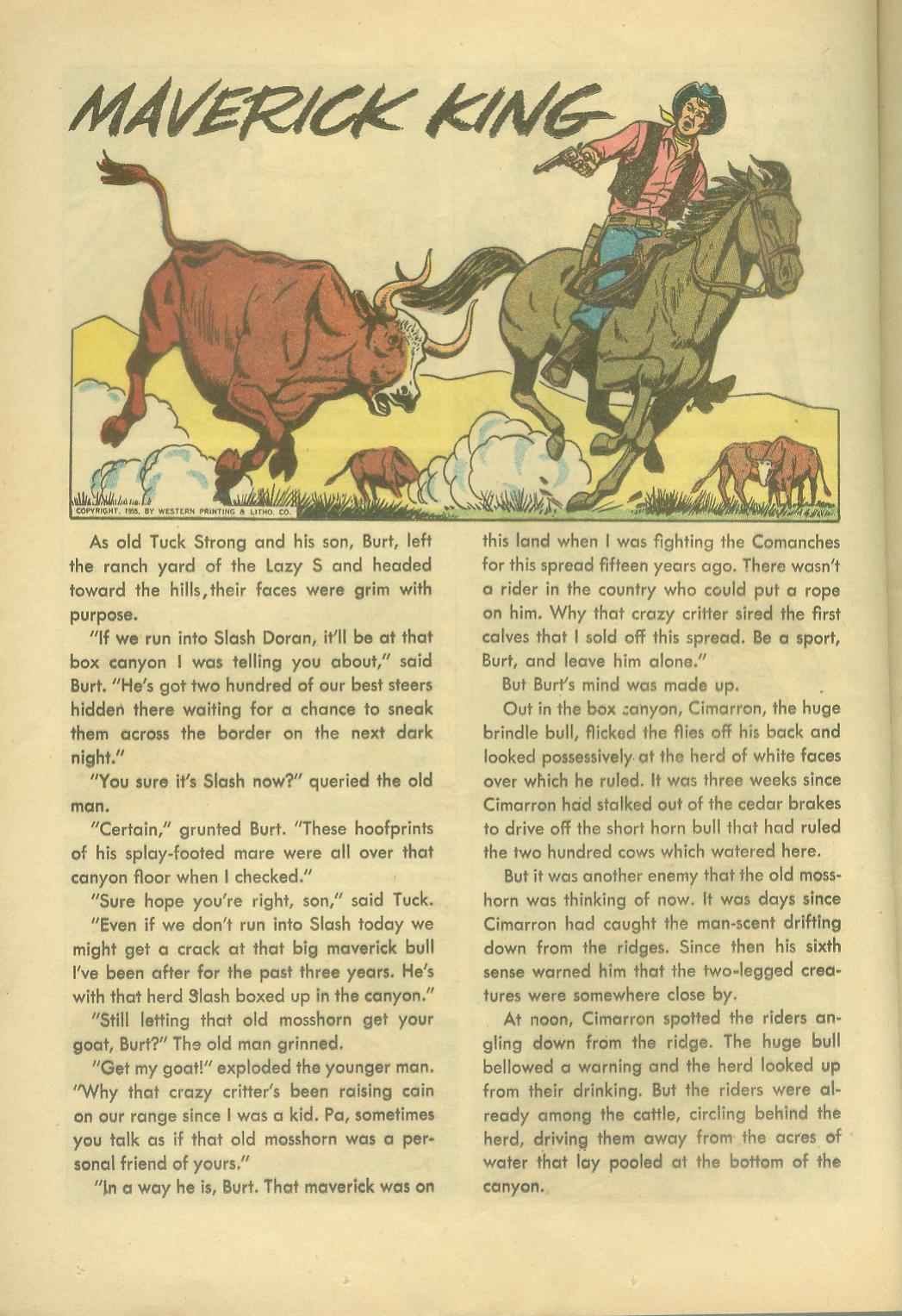
Next up, we have a two page text story with some very nice spot illustrations.

It's about a man and his son hunting for a stolen herd of cattle and talking about an old maverick bull that's never been captured.  When they finally find the herd, they are amazed to find that the maverick has already driven off the rustlers by himself.  You can read the whole thing below.


Usually, unless I'm reviewing a comic, I just skip by the text stories.  But this one was actually pretty interesting in that about half of it is told from the point of view of the maverick bull.  An unusual storytelling choice. The illustrations are also very nicely done.  Overall, I expected filler.  What I got was a pretty good little read.

NEXT!

YOUNG HAWK - THE GIANT TURTLE
SCRIPT: Gaylord Du Bois
PENCILS: Rex Maxon

Young Hawk and his brothers, Little Buck and Strong Eagle make camp beside a river.  Their rest is interrupted by a bear and a wolverine fighting over the meat the brothers have left hanging. 

After driving off the bear and killing the wolverine, the brothers continue their journey down the river. . .noticing the strange lack of young ducks, even though it's the season for them.

As their pet dog, Tumbleweed, swims through the river, he is suddenly pulled under water! Young Hawk dives in to save him and is astounded to see a gigantic snapping turtle.  He kills the turtle by cutting off its head, saving Tumbleweed.  The monstrous turtle will no longer trouble the animals or travelers along that part of the river again.

The End.


This story just didn't do it for me.  I have to admit that I'm not a fan of Gaylord Du Bois' writing in the first place, so I'm a little biased going in.  That said, I can give anything a fair chance, and given a fair chance, this one still falls flat.  

To be fair, the simplistic narrative, with its "This happened. Then this happened. Then this happened. The End" story path IS well-suited for the younger audience this comic was written for, and is characteristic of Du Bois' style in ANY comic he's written that I've ever read.  But where the simplicity of the opening Lone Ranger story gave it a snappy character, the simplicity here just makes the story feel like it's being written down to the lowest level of reader.

The art doesn't help.  After the surprisingly well done art in the first two stories, the art here feels like a big step backward and more into the territory I would expect in the interior of a Dell comic.  Compare the page above with the pages I scanned for the first two stories and you'll see what I'm talking about.  The art here isn't BAD. . .it's just a little disappointing.

Overall, this one was the weak point of this comic.  An overly-simple story backed up by some disappointing art just makes it feel like this effort was aimed squarely at a juvenile audience.  To be fair, on that front it succeeds. . .but it doesn't read very well to a modern reader because of it.

AND FINALLY. . .

To finish things off, we've got a couple of short page space fillers.  

The first is about Native American gourd lamps. . .


The most interesting thing about this little half-pager is that it was written by an actual Native American tribal Chief. . . Red Thunder Cloud of the Catawba Nation, who was a pretty interesting (and sort of controversial) character, according to his Wikipedia page.  So I liked this one not so much for the gourd lamp information (which was okay), but for the direction it took me reading about Chief Red Thunder Cloud.

The second page space filler is a little synopsis of the tragic history of the Black Hills.  It basically reads like an encyclopedia entry (For my younger readers, they were big sets of books we used to look things up before Google existed. . .God, I feel old).  Interesting, but ultimately there just to take up some unused space.  The "Dell Pledge" below it was actually more interesting to me.  It basically gives the justification as to why Dell comics never sported the CCA seal.


CONCLUSION

And there you have it, Lone Ranger #84 from 1955.  

Overall, I found this to be a quite enjoyable read.  The first two stories showcase the Lone Ranger as more of an investigator than as a gunfighter, and I really liked that a lot.  The third story wasn't to my liking, but taking a step back and trying to put myself in the shoes of a kid in 1955 paying a dime for this comic, it's not really that bad.  Heck, it's got a bear fight, a giant turtle, and Indians! What more could a kid ask for?

A lot of Golden Age comics don't age very well.  This one still reads pretty good even 66 years down the line, with the exception of the Young Hawk story. But even that wasn't enough to keep the grin off my face as I transported myself back to 1955, when westerns were at the top of the pop culture pile and The Lone Ranger stood strong and tall as one of the great American heroes.

If you are a Lone Ranger fan, you will love this comic!  Heck, the cover alone should be enough to make you love this comic.  But this comic will also appeal to fans of Golden Age western comics in general.  This was a lucky find for me, and it's a little more "valuable" than my usual Longbox Junk fare, so finding a copy in decent shape might be a bit difficult.  That said, keep your eye out!  I found this in "the wild" so there might be more of them out there just waiting to be found.

Up Next. . .

I'm thinking I'll spotlight another one of my recent great flea market finds.

But which one?  Stick around and find out. . .

Be there or be square!

Wednesday, October 7, 2020

Longbox Junk Halloween Retro Review - Dracula (1962)

Welcome back to Longbox Junk, where I write comic book reviews whether you ask me to or not!

It's that time of year again!  That's right, folks. . .it's October!  Leaves turning beautiful colors, the weather turning cool and crisp, and the sweet smell of pumpkin spice hand sanitizer!

We've been having a little Longbox Junk Retro Review Halloween party lately, but then I realized SOMETHING was missing!  What kind of Halloween party is it without that debonair creature of the night, Count Dracula?  In my humble opinion, it's not a party at all!

Let's go ahead and invite the dastardly Count into the house! 

DRACULA
DELL (1962)

COVER:  L.B. Cole (?) or Vic Prezio (?)

THE COVER:
I've said it before and I'll say it again.  In my extremely humble opinion, Dell and Gold Key comics had some of the all-time BEST comic covers!  Don't try to fight me on it, I'll defend that hill until the end! 

 This is another in a long list of fantastic painted covers from Dell.  It makes regular appearances on the Halloween version of my "Wall O' Covers" in my office at work.  What can I say about it?  Just LOOK at it!  THIS is what a Halloween comic cover is all about right here!  

THE STORIES:

Under that beauty of a cover there's one full comic story taking up most of the issue, along with three one page space fillers.  Let's take a look at them each in turn. . .

THE RUSALKI, WATER MAIDENS OF DOOM
(One Page, Black and White)
SCRIPT: Bernhardt J. Hurwood (?)
PENCILS: Robert Jenney (?) or Max Elkan (?)


Basically a one page piece on a mischievous Russian folklore creature similar to a siren.  Actually pretty interesting and well-illustrated.  It would have been nicer in color, though.  Not a bad appetizer for the main course.

On to the main story!

THE VAMPIRE'S CURSE
SCRIPT: Bernhardt J. Hurwood
PENCILS: Robert Jenney (?) or Max Elkan (?)

Our tale begins on a dark and stormy night as physician and staunch man of science, Sir Basil Shawcross speeds to the home of  Professor Janos Tesla, expert in literature and folklore, and a good friend of Shawcross. . .


Upon arrival, the distraught Shawcross demands Professor Tesla tell him everything he knows about the legendary creature known as the Vampire.  Tesla proceeds to inform Shawcross (and the reader) about the history and known powers of Vampires.  Shawcross seems reluctant to accept that such a supernatural creature can exist, despite his friend's belief. . .


Tesla asks Shawcross exactly why he's come so late and asking such strange questions.  Shawcross hands over a telegram announcing the death of his son, Bruce, in Transylvania, where he had been working as an artist.  

He continues with descriptions of his son's letters home, which started off normally until the night he met a mysterious, beautiful woman in a village graveyard, a woman named Irina who immediately captivated the young man over the course of the nights they met. . .


Bruce's final letters home spoke of his intent to marry Irina, as well as a strange illness that had come over him with a terrible weakness and vivid horrific nightmares.  Then the letters stopped, except for the telegram with the news of his death.

Shawcross is determined to travel to Transylvania to collect his son's body and find out what happened.  He wants Professor Tesla to accompany  him.  Tesla fears that Shawcross will be in grave danger travelling alone, so he reluctantly agrees. . .


Having some idea of the supernatural creatures they may encounter, Tesla makes preparations over the next couple of days before the two friends travel to Transylvania.  Upon arrival, they find suspicious villagers and discover that the body of Shawcross' son has gone missing!  


They decide to start their investigation at the inn where Bruce died.  Shawcross takes his son's room over the objections of the innkeeper.  That night, Shawcross wakes to find his supposedly dead son standing at the end of his bed!  

Bruce demands that his father accompany him at once and alone.  Shawcross reluctantly agrees, but as the pair set off in a carriage in the dead of night, they don't realize that Professor Tesla is following them. . .


In the carriage, Bruce introduces his father to Irina, informing him that they have been married.  Irina explains that they are travelling to meet her Uncle, Count Dracula, at his castle.  Upon arrival, Shawcross is introduced to Dracula while Tesla observes unseen. . .


As Dracula offers wine to Shawcross, Tesla rushes in shouting that they are all vampires and he's fallen into their trap!  Dracula admits that the game is up, and that he wanted to make Shawcross an offer. . .as a doctor, it will be easier to provide the vampires with blood than by hunting.  He offers Shawcross riches in exchange for his services.

Shawcross refuses and Dracula attacks, intending on turning the doctor into a vampire and forcing him to do the Count's bidding.  Tesla rushes to his friend's defense, using garlic and wolfsbane to drive the vampires back. . .but he's too late to save Shawcross, who has a heart attack during the fight.


As Shawcross lays dying in Tesla's arms, he asks him to save his son.  As the sun rises and Tesla brings Shawcross' body to the village, he decides to honor his friend's final wish and work toward finding a cure for the curse of the vampire. 


The End.

Okay.  Hmmmmm. . .

Not bad. Not bad at all.  A pretty good read.  The ending seems a bit rushed compared to the slow burn build up at the beginning of the story.  It looks like this was originally pointed toward an ongoing story with Professor Tesla vs. Vampires (that was abandoned in favor of the infamous "Superhero Dracula" series that came a few years later), which would explain the sort of dangling nature of the ending.

Other than that, I can't find much to fault in this creepy little tale.  It's well written, it has interesting characters, and I want to see what happens next.  Unfortunately, this is all we get of this story.

On the art side of things, I was pleasantly surprised to find some decent art in a Dell comic. . .which is a bit of a rare occurrence.  Dell may have had some of the best painted covers that have ever graced a comic rack, but the art inside is pretty consistently disappointing.  Is it the best comic art I've ever seen?  Not even close.  But compared to a lot of Dell's art, this stands as an exception to the standard "Great Cover. . .Lousy Interiors" I automatically assume whenever I see one of those great painted covers.

Overall, a nicely done story.  A good amount of meat on the bone to be found here.

Let's check out the final bits. . .  

THE HUNTERS OF THE FOREST
(One Page, Black and White)
SCRIPT: Bernhardt J. Hurwood (?)
PENCILS: Robert Jenney (?) or Max Elkan (?)


A one page article about the strange Slavic forest spirit called the Leshy.  Another pretty interesting read with some decent illustrations.  Like the first of these, it would have been better in color.  Other than that, not a bad little space filler.

AND FINALLY. . .

WITCHES' SABBATH
(One Page)
SCRIPT: Bernhardt J. Hurwood (?)
PENCILS: Robert Jenney (?) or Max Elkan (?)


Another one page space filler. . .this time concerning the Witches' Sabbath, and in color, unlike the other two one pagers in the issue.  This one has a lot more text, but I found it the most interesting of the three.  Not a bad finish.  Not quite a cherry on top, but not bad.

CONCLUSION

One of the best parts of these "Retro Reviews" for me is taking the opportunity to learn a little bit while I'm in the process of writing a review.  I look up the artists and writers, read up on them and what else they've done.  I check out whatever I can find on the comic itself to see if there's anything interesting or possibly controversial about it.  

During the course of writing this review, I DID discover something worth remarking on. . .but not about the comic itself, more about the modern information to be found on it. 

 It seems that about half of the sources of information on this comic (Including the specific Wikipedia page on Dell's Dracula comics) cite this issue as being an adaptation of the 1931 movie.  As you can see from the synopsis above, it is not.  I'm not sure if different sites simply copy and paste information without checking (that seems the case), but here at Longbox Junk we actually READ the comic at hand.  This is an original story, NOT an adaptation of the movie.

ANYWAY. . .

As for the comic itself, I found it to be well written and entertaining.  It's too bad this storyline was abandoned by Dell as they tried to move their line more toward superheroes, including their ill-advised attempts to turn Dracula, Frankenstein, and The Wolf Man into costumed heroes.

I'd certainly recommend this one to anybody wanting a decent Silver Age vampire story under a fantastic painted cover.  It might be a bit pricy to find a copy in decent condition, and it doesn't look like it's been collected or reprinted, but keep your eye out!

Up Next. . .

The Longbox Junk Halloween party keeps going!

The paper time machine is heading back to the Golden Age again for a look at 1953's Beware #13.

Be there or be square!

Monday, September 14, 2020

Longbox Junk Retro Review - The Lone Ranger #35 (1951)

 Welcome to Longbox Junk, where I write comic book reviews that nobody ever asked for!

Once again, I'm sorry for a bit of delay between entries this time of year.  I manage a hotel and we're fully in the swing of Utah tourist season right now. . .even though I've been assured by the fine folks on my television screen that it's SO unsafe to venture out of your home and stand in a line that we need to vote by mail this year.  I look at my packed parking lot, raise an eyebrow, and mutter, "Well, if you say so, I guess."

ANYWAY. . .

Long story short. . .the incongruous combination of a busier than usual tourist season and a hotel still running on a pandemic skeleton crew (for some reason I can't figure out) doesn't leave much time for comic readin' and reviewin'. 

BUT ENOUGH OF THAT. . .

I'm going to continue my "mini-series" of Longbox Junk Retro Reviews for a little while longer, since I've been having a lot of fun stepping outside of my usual bargain bin fare and shining the spotlight on some of the older and/or more "valuable" comics in my collection.

This time out, I'm setting the Longbox Junk paper time machine to 1951 and heading back to the days when Cowboys were king of the hill in movies, T.V. and comics for some wild west fun with one of my personal favorite characters of all. . .The Lone Ranger!

In MY extremely humble opinion, when it comes to heroes, the Lone Ranger has it all!

A tragic origin, a faithful sidekick, an iconic look, and a never-swerving determination to help others.  He may have changed a little bit here and there over the years (witness the original red shirt outfit on the cover below), but one thing about The Lone Ranger remains steady and firm. . .he will ALWAYS do the right thing, no matter how dangerous it may be.  He's not just a great western hero, he's a great hero, period.

Is it any wonder that the adventures of that mysterious masked man of the west have lasted since 1933 when so many other characters have come and gone?  How can you NOT like a hero that says things like, "I believe that to have a friend, a man must be one."  Or, "Everyone has within himself the power to make this a better world." 

 While Batman is slowly spiraling into the madness of the monsters he fights and Captain America's status as the bright symbol of a strong nation is being steadily eroded, The Lone Ranger is the hero that steps forward and tells you that he'll be your friend if you need one.  In these times of trouble, we NEED a hero like The Lone Ranger!

But enough introduction.

Let's get that paper time machine running and head back to the Old West by way of 1951, shall we?

We shall!

THE LONE RANGER #35

DELL (1951)


COVER: Ernest Nordli (?)

THE COVER:
It's just a beautiful thing! A fantastic moment of action frozen in time with wonderful colors, composition, and sense of motion.  This is one of my favorite covers in my collection and was the reason I bought this comic for probably a little more than what it's actually "worth", but you know what? I would have paid more if I had to!  I mean, LOOK at that cover! There's no such thing as a perfect comic cover, but in my opinion, this one comes pretty close.  They certainly don't make 'em like this anymore. Let's get inside. . .

THE STORIES:
Never let it be said that Golden Age comics don't deliver their money's worth!  For a single lousy dime we get three full comic stories, a short text story, a single page article on different saddle styles. . .


AND a very nice piece of full back cover art to go along with the awesome cover up front. . .


That's a good chunk of comic for ten cents! Let's take a look at all this stuff in here.

SHANGHAIED
REPRINTED FROM 1944 LONE RANGER NEWSPAPER STRIPS
SCRIPT: Fran Striker 
PENCILS: Charles Flanders 

The Lone Ranger and Tonto come to the aid of a wealthy banker in San Francisco whose daughter has fallen into the clutches of a notorious seafaring criminal named Shark Dawson.  After reading the ransom note, The Ranger decides to pay a visit to Dawson's known criminal confederate, Stingaree, owner of a dangerous dockside tavern where men commonly go missing. . .shanghaied for the crews of Dawson's ships.

Donning what is possibly the world's worst disguise, The Ranger allows himself to be knocked out and captured by Stingaree, then delivered to Dawson's ship as a kidnapped crew member. 

Nobody will suspect a thing!

In the meantime, after The Ranger has been taken to Dawson's ship, Tonto rushes into Stingaree's bar and informs him that the Lone Ranger has been taken aboard in disguise, sent by the banker to rescue his daughter!  Stingaree panics and rushes with all his men to Dawson's anchored ship to warn the Captain and try to find the disguised Ranger.  Tonto ambushes one of Stingaree's men, disguises himself, and rows out to Dawson's ship among the rest of the thugs, unnoticed.

Aboard the ship, as Stingaree's gang search for the Ranger, he and Tonto rendezvous and make their way to the Captain's cabin where the banker's daughter is being held.  They subdue the guards and then Captain Dawson himself.  As The Ranger, Tonto, and the banker's daughter make their escape in the darkness, The Ranger decides that now the banker's daughter is safe, he's also going to rescue the kidnapped crew members and take down Dawson's gang.

Tonto and The Ranger creep through the whole ship in the darkness, subduing any gang member they run across and sending any kidnapped crew to the waiting lifeboat with the banker's daughter.  When they are done, the only men left on Dawson's ship are Stingaree's gang. . .now themselves forced into service as Dawson makes his escape.  The Lone Ranger is satisfied with his good night's work.

THE END.

Okay, not bad.  It's a pretty simple story at heart. . .The Lone Ranger vs. Pirates. . . and it's obviously written for a younger audience, but there's nothing wrong with that.  I just have to try and look at it from the point of view of who it was written for instead of as a modern reader.  Coming from that direction, this story combines two things kids love. . .Cowboys and Pirates! I'm thinking that for the 1950's kid who spent their dime, this is a great, action-packed story that shows the Lone Ranger and Tonto in a bit of an unusual setting. For a modern reader, maybe not so great.

The Ranger's "disguise" is unintentionally hilarious, and the ending is confusing (He lets them all escape, being satisfied with the "poetic justice" of the kidnappers becoming the crew instead of taking them in to the law).  But with a bit of research, I've learned that with the Lone Ranger there were certain specific guidelines for the character. . .such as his NEVER taking off the mask. . .that writers had to work around.  So I can look past some of the odd things in this story knowing that.  Other readers might not be able to.

As far as the art goes, it's surprisingly good.  It has a very cartoony style that is pretty appealing to the eye.  Backgrounds are a bit sparse, but that's to be expected from a story that originated in a daily comic strip.  What really surprised me was that the coloring was actually good here.  I've found the coloring to be a pretty common problem with older comics. . .usually very sloppy or garish or both.  Here it's not bad at all.  So overall, no problems with the art.


All in all, a pretty good story.   For a modern reader, there's a few things that are a bit clunky, but for the kids this was written for, it's a story full of action and adventure that brings the Lone Ranger and Tonto out of their usual setting for a little bit of Pirate Punchin' on the high seas! 

NEXT!

THUNDER MARTIN
REPRINTED FROM 1944 LONE RANGER NEWSPAPER STRIPS
SCRIPT: Fran Striker
PENCILS: Charles Flanders

Thunder Martin is a giant of a man, and a menace to a small town.  Unfortunately, the local sheriff doesn't have enough evidence to make any charges stick. The Lone Ranger decides it's time to put him out of commission.

First, he brings Thunder in to the Sheriff on charges of property destruction.  The Sheriff tells the Ranger that without Thunder's gang and some real charges, putting him in jail will only cause more trouble.  The Ranger confides that he's got a scheme in mind.

They enlist the help of the shortest man in town, Pee-Wee Grimes, and lock him in the same cell as Thunder Martin. . .handcuffing the two men together.  Later that night, The Ranger enlists the Sheriff's daughter to stage a jailbreak under the pretense of feeling sorry for Pee-Wee.

After the two men make their escape, Thunder heads straight for his hideout so that he can break the handcuffs keeping him leashed to Pee-Wee. . .who he plans to kill after breaking free, so that Pee-Wee won't reveal where Thunder's hideout and gang are.

Fortunately for Pee-Wee, The Lone Ranger, Tonto, and the Sheriff are following Thunder Martin unseen as he leads them to his hideout.  The lawmen make short work of Thunder's gang and recapture him. . .this time with stolen goods and Pee-Wee as a witness to his plan to kill him.

The next day in court, Thunder is sentenced to hang, but he manages to escape, intending to kill Pee-Wee Grimes for helping trick him and testifying against him.  The Ranger and Tonto catch wind of Thunder's escape and they head directly to Pee-Wee's ranch, where they manage to save him and recapture Thunder so he can hang the next morning.  All's well that ends well!

THE END.

Okay. . .not bad.  Not quite as good as the first story, though.  The Lone Ranger's scheme seems to be needlessly complicated and he's actually using an innocent man as bait.  The Sheriff mentions this several times through the story, but the Ranger just sort of ignores his concerns.  In the end, the bad guy pays the price for his deeds, it's just how he gets there seems a little out of character for The Lone Ranger. It's actually sort of a dark story if you think about it.

I guess it's just me looking at the story from a modern reader's point of view.  From the point of view of a kid in the 50's reading this, I see a story of the Lone Ranger and Tonto tricking a rotten criminal into giving himself away.  Bad guy loses, Good guys win.  Simple as that.

As far as art goes, it's the same artist as the first story, so it has the same exaggerated cartoony look and sparse backgrounds.  More of this story takes place during the day, so the colors are a bit more garish than in the first story, but not so much as to ruin the art the way bad coloring tends to do in a lot of the older comics I've read.


Overall, not a bad little story.  Not quite as good as the first story and actually a little dark in the Ranger's casual use of an innocent man to trap a criminal, from a modern point of view.  From the point of view of who this story was written for, it's very simple and action-packed tale of good vs. bad.

NEXT!

THE RESCUE OF LITTLE CROW
TEXT STORY WITH ILLUSTRATIONS
SCRIPT: Gaylord Du Bois
PENCILS: Jon Small

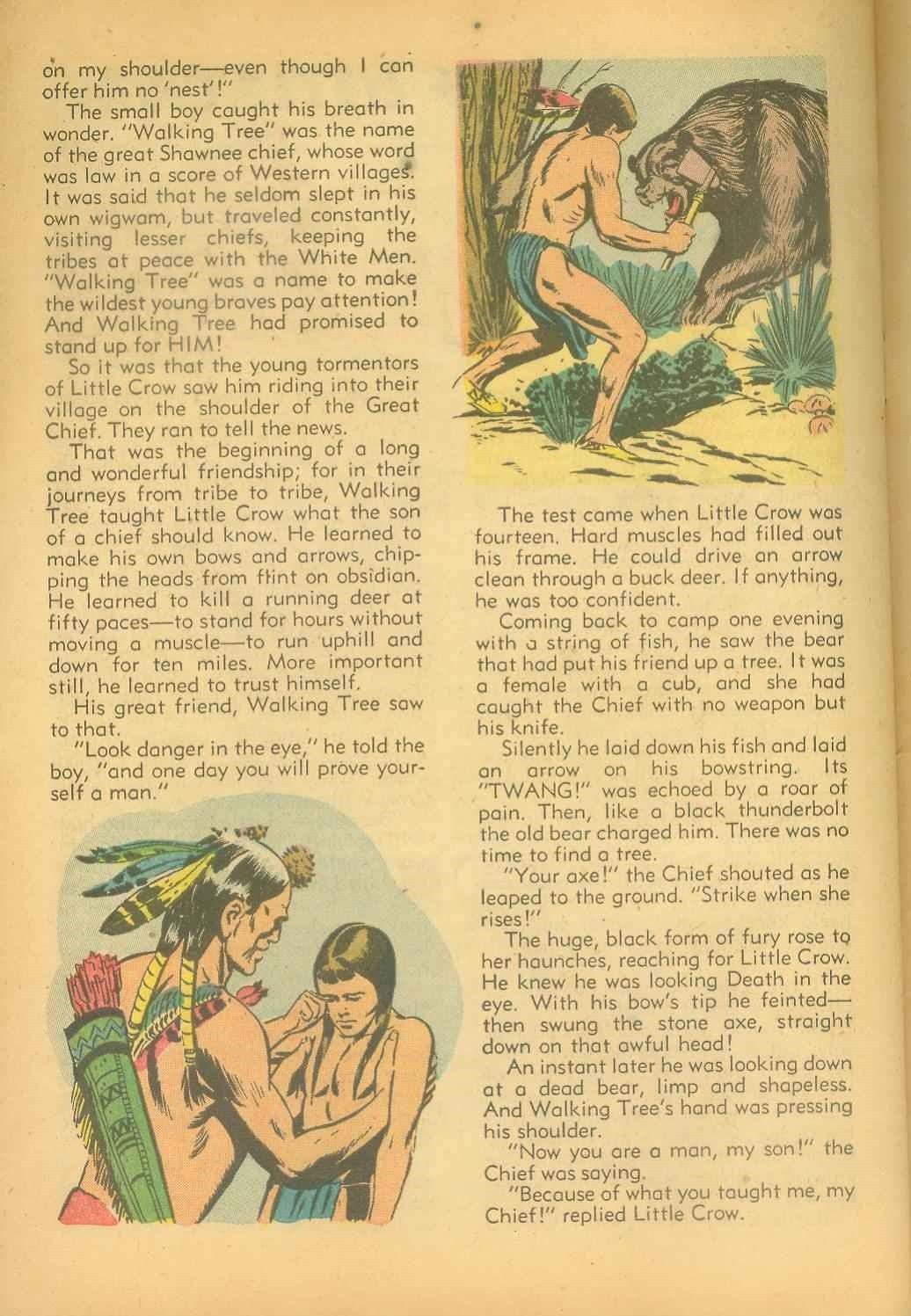
Next up is a two page text story written by Gaylord Du Bois, a prolific comic writer (one of the most famous characters he created was Turok, Son of Stone) and the author of the original Lone Ranger novel, which is a great read that's ACTUALLY more of an origin story for the Ranger's horse (Silver) with the Ranger as more of a supporting character!  If you're looking for some great pulp western fiction, then definitely try to find a copy.  But let's see what THIS story is about. . .

A bullied young boy named Little Crow is taken in by the great chief, Walking Tree, who teaches him the ways of life and being a man.  Little Crow's journey to becoming a great warrior under the guidance of Walking Tree comes to its best moment when the young man risks his own life to save a friend from a bear.


Truthfully, this was my favorite part of this comic.  I'd venture a guess that for the audience this comic was written for (young boys in the 1950's), this was probably the LEAST favorite part of the package, but to my modern eye Du Bois' punchy and descriptive prose is a great example of pulp fiction writing. . .even better for managing to tell a good story in an extremely limited space.  Reading this makes me want to get  my copy of the original Lone Ranger novel off the shelf and read it again!

AND FINALLY. . .

YOUNG HAWK: THE TURKEY HUNTER
SCRIPT: Gaylord Du Bois
PENCILS: Jon Small

We join Young Hawk and his brother, Little Buck, on a journey in progress along the Mississippi river shortly after losing their canoe during a bear attack (this story was a continuing Lone Ranger back-up starting with issue #11).

They find a new canoe with dead braves in it, letting them know that there are hostile tribes nearby.  After taking the canoe for themselves, the brothers are caught in a raging storm, where they see a herd of buffalo scattered, picked up, and thrown around by a tornado.

Several days after escaping the tornado, Young Hawk and Little Buck are pursued by hostile warriors. The brothers are forced to hide on the river bank after Young Hawk is wounded by an arrow.  They finally manage to escape under cover of darkness.

Days later, Young Hawk spots a plump turkey on shore.  He decides to go hunt it because the brothers are tired of eating fish.  As he prepares to take a shot on the turkey with his bow, Young Hawk hears a rattlesnake and sees a stranger about to be bitten!  Little Hawk kills the snake and saves the stranger, but loses the turkey in the process.  

The stranger introduces himself as Eagle Wing, a Chickasaw.  He declares his life to be in debt to Young Hawk and Little Buck, naming them as friends of his tribe and welcome at their camp.

THE END. 

Hmmmmmm. . .okay.

I did a review of  Dell's Four Color #656 from 1955 featuring the second appearance of Turok, Son of Stone, and also written by Gaylord Du Bois, at the beginning of this little series of looking at some of the older comics in my collection (You can read the entry HERE ).  

I wasn't a big fan of the writing because it seemed less like an actual story and more like a series of "They went here and did this.  Later, they went there and did that." vignettes.  This story suffers from exactly the same thing.  You can see from the summary that it's basically three unrelated events hanging on the framework of two brothers going down a river.  They aren't presented in any especially exciting way. . .more of a "This happened.  That happened" sort of almost documentary style.

Of course, looking at it from the point of view of the kid it was written for, you have the journey of two young boys on their own without any adults and facing the dangers of the wilderness, using their meager resources and wits to prevail.  Coming at it from that direction, it's not a bad little story.

Unfortunately, when I look back just a few pages and see Du Bois writing a pulpy, descriptive narrative in the sparse confines of ONE page front and back, and then seeing a comic story that doesn't even look like the same person wrote it, I realize that Du Bois may have been a prolific comic scripter that deserves a place in comic book history, but in MY extremely humble opinion, he's obviously a much better prose author.

The art changes with this story to a more darkly-inked and realistic style, with more detailed backgrounds.  It's not bad.  Probably better than the first two stories from a technical point, but for some reason it's just not as interesting as the other art style.  I can't even really put my finger on why.  Like I said, it's not bad at all.  It's just sort of. . .there.  It does a good job of telling the story, but doesn't try too hard to do anything else.


Overall, this story sort of fell flat for me.  It's not BAD, but it suffers from an extremely straightforward and documentary style of storytelling that probably didn't matter much to the kids this was originally written for, but I find it hard to ignore as a modern reader.  Don't get me wrong, I've read MUCH worse when it comes to Golden/Silver Age comics.  It's just that the scripting is a little too dry for something featuring buffalo getting thrown around by a tornado.

CONCLUSION
One of the things I like best about these Longbox Junk "Retro Reviews" is that it gives me an opportunity to educate myself a little bit while writing the review.  A lot of what I look up never makes it into the review itself, beyond maybe a little mention (Like the specific requirement that the Lone Ranger NEVER remove his mask, I tossed out above), but I wouldn't have any other reason to look up someone like Gaylord Du Bois or Ernest Nordli (my best guess for cover artist) otherwise.  

So when I write one of these reviews, one of the MOST common things I learn is that there really isn't that much information out there on many older comics.  So the opportunity to educate myself comes circling back around as I reveal what's under the cover of the comic for others who may be looking for information. 

Good or bad, when I write what will probably be the one and only review of the contents of an older comic like the one at hand, I get a nice feeling of satisfaction that I've contributed a little something to the general comic knowledge out there.  I'm not trying to blow my own horn here or make a review of a Lone Ranger comic more than it is.  I'm just saying that if you happen to come across this review while doing a Google search for information, I hope you enjoy reading it as much as I enjoyed writing it.

ANYWAY. . .

As for the comic itself.  It's pretty good.  It's not the greatest comic I've ever read, but for something written for young boys in 1951, it holds up pretty well to a modern reading.  The first story gives us the Lone Ranger and Tonto out of their usual backdrop of dusty western towns and fighting pirates on the high seas.  The second story is extremely simple in nature, but has a somewhat strange layer of darkness underneath it when viewed through a modern lens.  The third story is lacking in excitement, but is still pretty interesting.  And the text backup is an unexpected little gem of pulp western writing.

If you're a fan of The Lone Ranger or early western comics in general, you'll definitely get more mileage out of this than other readers.   You won't find it in the bargain bin, and it doesn't look like it's ever been reprinted or collected, but if you should spot this at a reasonable price, I say go for it! It will make a very nice addition to any collection including western comics.

Up Next. . .

I think I have time for another couple of Retro Reviews before I turn my attention to some Halloween fun in October!  I picked up a copy of She-Hulk #1 last year that I haven't read yet.  I think it's time to fix that.

Be there or be square!