Showing posts with label The Falcon. Show all posts

Monday, July 6, 2020

Longbox Junk - Captain America: Marvels Snapshots

Welcome back to Longbox Junk, where comics are worth more than money.  That's my way of saying that if someone broke into my house to steal my comic collection, they'd find it more trouble on their back hauling them out than what the job would be worth  . . .BUT I DIGRESS!

I've said it before, and I'll say it again. . .I'm a sort of patriotic guy.  I come from a long line of military men, and as a proud veteran of the U.S. Marine Corps myself, I tend to be a bit of a flag waver and I ain't ashamed to admit it. And with times the way they are, maybe we need to wave the flag just a little.

Wait! Wait. . .don't go!  I'm not gonna get political.  I'm just introducing the Longbox Junk "theme" for July!  It's Captain America, okay? I'm going to be looking at some Captain America comics through this month. 

BUT. . .

It IS Captain America, so if you aren't the kind to tolerate a little "AMERICA, %$#& YEAH!" in your funny books, then maybe you might want to skip the next few posts. But come back in August!

Okay, everyone in that's staying in?

Let's start this off by stepping outside of the usual Longbox Junk bargain bin finds with a little something brand new and on the shelves right now.

DC gets a bit of flak for squeezing every possible drop out of their seminal "Watchmen" series by constantly trying to add to something that doesn't really need anything added to it. But never let it be said that Marvel isn't just as guilty of the exact same thing with their own critically acclaimed series, "Marvels".

What we have here is the first of a new series of one shots trying to capitalize on what little magic is left in Kurt Busiek and Alex Ross' masterwork of seeing superheroes through the eyes of the common man.

The series is called "Marvels Snapshots", and the first one out of the gate features Captain America (and The Falcon) in a continuation of Jack Kirby's 1970's "Madbomb" storyline. . .the first issue of which (Captain America #193 from 1976) got a a fine Longbox Junk Retro Review  HERE .

SO. . .

We've got a one shot walking the tightrope of adding to a fan favorite series that doesn't really need anything added to it AND trying to continue a classic Bronze Age story from one of the giants of the comic world.  It's got some work cut out for it.  Let's take a look!

CAPTAIN AMERICA:
MARVELS SNAPSHOTS
MARVEL (2020)

SCRIPT:  Mark Russell
PENCILS: Ramon Perez
COVER: Alex Ross

THE COVER:
Marvels was the series that put superstar artist Alex Ross on the mainstream map, so it's a good call in my book getting him on board to do the covers of the "Snapshots" one shots.

As far as the cover itself, it's a great portrait shot of Cap painted in Ross' trademark hyper-detailed and realistic style.  I love the determination in Cap's eyes and the grim set of his jaw!  I don't know who's about to get punched, but I can see by the look on Cap's face that they definitely deserve it.  Alex Ross is a fantastic visual storyteller and in this simple shot of Cap getting ready to deliver a New York Special, there's a story being told.

It's not the greatest Captain America cover ever, but this is definitely worthy of a turn up on the rotating "Wall O' Covers" in my office at work.  Let's get inside and see what else is going on here.

THE STORY:
Felix Waterhouse is a teenager living in a poor South Bronx neighborhood.  Extremely gifted with electronics, he's working in his father's television repair shop and trying to earn enough money to escape poverty and go to college.

BUT THEN. . .

The Madbomb attack hits Manhattan.  Felix's neighborhood is on the edge of the attack, but it is still devastated by the ensuing riots before Captain America manages to destroy the device causing people to go mad and attack each other.


In the aftermath of the Madbomb attack (during which Felix's mother kills his little brother), life returns to normal for most of the city.  The superheroes of New York turn their attention to new threats as the city begins to rebuild.
Unfortunately, conditions in Felix's neighborhood only get worse as the devastation of the Madbomb causes businesses to leave and gangs to move into the blocks of  abandoned and burnt out buildings.  Crime is rampant and even worse, loss of business at the T.V. repair shop means that Felix has to spend his college savings just to keep his family going.


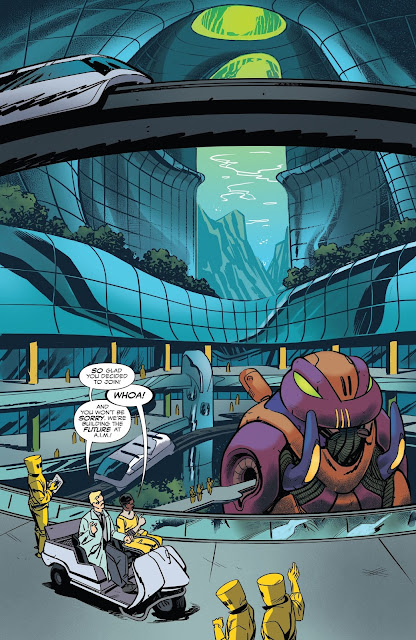
Things are looking bleaker and bleaker for Felix until one day a mysterious man comes into the shop with a strange offer. . .he represents an organization interested in Felix's talents with electronics and will give him a good job, as well as pay for his college education.  The catch is that the organization he represents is A.I.M.  A well-known part of the villainous Hydra!

Felix declines at first, but as he sees repairs being made to the wealthier sections of the city while neighborhoods like his are ignored, he decides to take the man up on his offer.  He is taken to an elaborate secret research base hidden beneath Manhattan to begin his new life.


Felix quickly fits in with his new A.I.M. colleagues and his extraordinary talents with electronics gain the attention of his superiors.  Because of this, he is one day taken to the most restricted level to assist with problems plaguing an ultra-secret project.  When he arrives, Felix is amazed to see that A.I.M. is trying to build a massive Madbomb of their own!

As he joins the Madbomb project, Felix slowly begins to realize that by helping to create a weapon of mass destruction, his talents aren't helping make a better future for anyone, and that his whole life is now built on lies.  He decides to sabotage the Madbomb, but is caught in the act.


After Felix is informed that he knows too much and has to die, he desperately activates a pulse meant to destroy the Madbomb, but his unfinished device is stronger than he expected and the resulting effect is enough to attract the attention of Captain America, The Falcon, and Iron Man, who quickly make their way to the hidden A.I.M. base and attack!


During the battle, the Madbomb is destroyed and Felix is rescued by the superheroes.  He informs them that he is the one who disabled the bomb and Iron Man is impressed by the young man's technical know-how.  A few days later, Felix is surprised to receive a job offer from Stark Industries.  


In the end, Captain America and The Falcon help with the long-overdue reconstruction of Felix's devastated neighborhood after realizing that simply defeating a problem and then ignoring what comes afterward doesn't solve anything and sometimes makes things worse. 


Lesson taught.  Lesson learned.  The end.

THE REVIEW:
What we have here is less of a Captain America story and more of a Felix Waterhouse story. . .which is a little disappointing right out of the gate considering the giant picture of Captain America on the cover and the fact that this is sold as a Captain America story.

SO. . .

Let's look at this from the angle of it being the story of a young man seduced by Hydra with Captain America and friends in a supporting role.  On THAT side of the coin, it's not a bad story.  I do like the way that it looks into the aftermath of the original Madbomb attack from Captain America #193, so as an epilogue to "Madbomb" I think this story actually does a good job.

Felix is a pretty interesting character. Seeing him put his morals aside to try to make things better, realizing that he's been seduced by lies, and finally trying to make things right is a pretty good character arc.  Yeah, it's been done before and done better, but sometimes a little "If it ain't broke, don't fix it" is okay if it's done well.  Here, it's done well.

The story DOES get a little preachy toward the end as we get a healthy dose of "Superhero is forced to realize that the little people count too" moralizing.  It's not QUITE to the point of being cringeworthy, but it's pretty close to that edge.

So this story works as a sequel to Madbomb that digs in and takes a close look at the consequences of the original 1976 story from the perspective of one individual. . .but as a "Marvels" expansion, not so much.

The story of Marvels is rooted in an ordinary man's lifetime of observing Godlike beings around him without his really understanding them.  Here, the ordinary man understands MORE than the heroes.  It sort of defeats the whole point of Marvels in that these are extraordinary beings in the world of ordinary people when the ordinary person is ALSO the extraordinary in this story.

Marvels put the reader in the shoes of an ordinary person.  It made us feel the awe and wonder of seeing a man fly, or throw a car.  This story has none of the magic of Marvels and makes Captain America feel small and unimpressive as a teenager teaches him a lesson.  Maybe it was the writer's intention to make Captain America seem small instead of the powerful force rushing through an ordinary world he appeared as in Marvels. . .


I said at the top that I wasn't going to get political, but it seems to me like Captain America being humbled by a black teenager about what parts of the city got repaired first after an attack has a definite whiff of recent social justice trends to it.  It makes Captain America less of a hero and more of a representative of "privilege".  This perspective might not sit well with some readers.

CONCLUSION
In my introduction I said that this one shot had some pretty heavy work cut out for it.  Not only is it expected to add to a fan favorite story that doesn't really need anything added to it, but it ALSO is trying to be an epilogue to ANOTHER fan favorite story.

As an epilogue to "Madbomb" it works pretty well as it tells a story set in the aftermath of the original attack and after the heroes turn their attention elsewhere.  It has an interesting main character and follows a pretty good arc for a one issue story.

BUT. . .

As a "Marvels" supplement, it doesn't stick the landing.  Where Marvels is a timeless story about the awe and wonder of superhumans in the ordinary world, THIS story is firmly rooted in this particular moment in time by reducing Captain America to a representative of "privilege" that needs to be taught a lesson in social justice by the teenage protagonist.

It's not a BAD story.  But it certainly won't sit well with many Captain America fans that prefer to see the Star Spangled Avenger painted in a more heroic light.  If you are one of those fans. . .I'd say steer clear.  But if you are of the mind that there's some room in your superhero stories for a little social justice agenda, then definitely check this one out.  

Up Next. . .

More Captain America!

Steve Rogers is America's only "Super Soldier", but he hasn't been tested in the field yet.  Join me as I take a look at the story of Captain America's first Nazi-Bustin' combat mission in 2011's Captain America: Fighting Avenger one shot.  SPOILER: Everything goes wrong!

Be there or be square!

Monday, September 30, 2019

Longbox Junk - The Falcon

Welcome back to Longbox Junk, home of comic reviews nobody asked me for!

I really like The Falcon as a character. I'm gonna step outside the lines here and admit that I REALLY liked Sam Wilson as Captain America and was pretty disappointed that Marvel didn't have the guts to hold the line on keeping Steve Rogers an old man passing the shield on to a worthy successor.

THAT SAID. . .

The Falcon has always had a bit of a problem carrying a series. It's like Marvel feels like they HAVE to somehow keep him in the lane of literally being a Social Justice Warrior, and to me that's okay. . .in small doses. Eventually it breaks down because you can't have a character that only appeals to a certain way of thinking over the long term. I'm not being racist or any other kind of -ist. . .just telling the truth.

So what we have here is The Falcon's first solo run. A 4 issue limited series from 1983. There's a definite difference between the first issue and the other 3 because the first issue was actually done in 1981 as a standalone story for the upcoming "Marvel Fanfare" title that was never used.

Sam Wilson didn't get another Solo series for THIRTY-TWO GODDAMN YEARS with "All New Captain America" in 2015. . .The whole thing reviewed for your reading pleasure by yours truly HERE:

https://longboxjunk.blogspot.com/2018/05/longbox-junk-all-new-captain-america.html

Let's take a look at the series at hand and find out if we can find any clues why The Falcon as a solo character didn't really catch on, shall we?  We shall!

THE FALCON
Vol. 1 (1983)
Marvel Comics

ISSUE ONE: WINNERS AND LOSERS


SCRIPTS: Jim Owsley
PENCILS: Paul Smith
INKS: Vince Colletta
COVER: Paul Smith

Social Worker Sam Wilson (AKA The Falcon) fights in both of his identities to save a young man from going down the wrong path.

In the meantime, Falcon teams up with a hard-hitting detective to take down an armored criminal intent on destroying a new housing project.

The first part of this mini is basically a self-contained issue following two storylines.

The first, with Falcon trying to keep a young man out of trouble and put him on the right path introduces us to Sam Wilson : Social Worker and firmly sets the scene in ghetto Harlem. It also serves to introduce Sgt. Tork. . .a cop who breaks the rules to get the job done, but a good cop.

The second storyline involves a new housing project being built that is attacked by an armored villain calling himself "Nemesis". It eventually turns out that Nemesis is actually the slum lord developer of the building trying to pull an insurance scam.

Both of the stories taken together are pretty enjoyable and well-written. The first has more character moments and the second delivers the superhero fighting action.

What I like a lot about the writing here is that it seems like you're dropping into a story in progress. There's no Falcon origin story here, and even though this is listed as Sgt. Tork's first appearance, there's no origin for him either.

The writer doesn't hold your hand here, he just lets the story start like it's already been going on without you. . .but there's JUST enough exposition so it's not hard to figure out what is what. Very well done, and there's modern writers who could certainly learn a thing or two along these lines.

The only real problem is that the dialogue is definitely dated. There is no mistaking that this comic comes from the early 80's because it's just dripping with a "The 70's ain't QUITE over yet. . .dig?" tone.

The art is really quite good for a mainstream superhero comic coming in at the end of the Bronze Age. It's fluid and detailed, with a great sense of movement and animation. It's also colored well, unlike a lot of late 70's/early 80's comics I've read.


Can you dig it? I can dig it.

Overall, despite some really dated "street talk", I liked this first issue a lot. Even though it's an introduction, it doesn't feel like one at all.  NEXT!

ISSUE TWO: LEGION


SCRIPTS: Jim Owsley
PENCILS: Mark Bright
INKS: Mike Gustovich
COVER: Paul Smith

When Falcon fails to show up and keep the peace during a parade, Harlem erupts with violence and rioting after a rookie cop accidentally kills a gang member.

MEANWHILE. . .

In the THIRD retcon (in the 9 years of the character's existence at that point) of his origin, Falcon battles a Sentinel and discovers that he's probably a mutant.

First off, we get an art team change beginning with this issue. Although it's not BAD, the first issue's art team is clearly superior.

The ink lines are thinner, the backgrounds are busy enough with detail that the main focus is sometimes lost, there's a lot of "movement lines" that are pretty distracting during action scenes, and the coloring gets a bit sloppier.

Featuring the most talkative Sentinel EVER!

Overall, the art goes from interesting and engaging to typical 80's comic fare. Like I said. . .it's not BAD, just disappointing after the great job done on the first issue.

ANYWAY. . .the story.

Most of the discussion and information I could find about this mini on the internet revolves around this particular issue, as it tries to retcon Falcon into being a Mutant (probably to tie him into Marvel's cash cow X-Books of the time).

It seems a bit of a stretch, especially since they do some exposition on Falcon's "Snap Wilson" origin in the very next issue. Plus it seems like more of a weak excuse for a fight against a Sentinel than anything. I guess I can't blame Marvel for trying.

The second storyline, involving Harlem erupting into violence when a cop shoots an innocent man during a parade, is more interesting even though Falcon doesn't show up until the end of it after escaping the Sentinel and realizing he's got a hell of a mess to clean up.

Overall, this issue is a slip in quality from the first. The art change is for the worse and most of the issue is taken up with Falcon punching a giant robot.

It's not BAD, it's still pretty good. Unfortunately, it's not much more than that.

ISSUE THREE: FAITH


SCRIPTS: Jim Owsley
PENCILS: Mark Bright
INKS: Mike Gustovich
COVER: Alan Kupperberg

After the Harlem riots, President Reagan visits on a fact finding tour, only for the motorcade to be attacked and the President kidnapped by The Legion. . .the strongest street gang in Harlem.

Meanwhile, Electro attacks The Falcon after mistakenly believing that Falcon has discovered his Harlem safe house, preventing Falcon from helping recover the kidnapped President.

And then Captain America shows up.

Unlike the previous two issues, where they were basically two connected but separate stories, this issue contains a single story continued directly from the previous issue's riots.

It's mostly action, with Falcon rescuing people from fires and then battling Electro through most of the issue. There are some decent story moments that mostly revolve around exposition of Falcon's "Snap Wilson" criminal background origin story, but mostly it's Falcon and Electro fighting it out for pretty much no reason. . .Electro mistakenly believes that Falcon is looking for him, so he goes on the attack.

The art in this issue is the worst of the bunch so far. The panels are extremely cluttered and the coloring is pretty bad. It all looks extremely rushed. The reveal of Captain America on the last page is a particularly poor rendition of the Star Spangled Avenger.


Found in the internet dictionary under: Lazy Coloring

Overall, the worst issue of the series so far. It's mostly super people punching each other for pretty much no reason rendered in a rushed, badly-colored manner.

And finally. . .

ISSUE FOUR: RESURRECTION!


SCRIPTS: Jim Owsley
PENCILS: Mark Bright
INKS: Mike Gustovich
COVER: Joe Rubenstein

Captain America and The Falcon take separate paths to the same goal: Rescuing the kidnapped President of The United States from Electro and The Legion.

This final issue wraps up the series with a lot of punching topped off with a heaping helping of Political Progressive Agenda.

What I'm trying to say here is that if you are they type of person who might have a problem with a perception of "SJW Taint" of today's comics. . .your head will friggin' EXPLODE from this issue.

The implied progressive agenda present in today's comics are pale and weak compared to the straightforward urban liberal progressive message laid out in this comic. Fair warning.

That said, I want to throw out that I'm NOT the guy who is going to grit my teeth at SJW messages in comics. I LOVED Sam Wilson as Captain America and sincerely wish that Marvel had the guts to keep it that way. . .but even as Zen as I can be about this stuff, this comic was a little too much.

Like I said above, it's mostly fighting. . .but it abruptly stops and becomes a social justice PSA about how much life sucks for minorities. . .filtered through the lens of Ronald Friggin' Reagan being mansplained by a gang member while tied to a chair with Captain America and The Falcon just standing there nodding in agreement.

Wait. What?


Colonel Trautman? When did YOU become President?

Overall, I found this concluding issue to be a bit of an eye-roller. Not only is the Social Justice message extremely heavy-handed, but the art barely hurdles the bar of "okay". The depiction of Captain America is pretty bad, and Ronald Reagan looks more like a discount Richard Crenna.

CONCLUSION

This limited series can be described in one word: Conflicted.

It's pretty plain to see that the writer wanted to focus more on the Sam Wilson: Social Justice Warrior aspect of the character than The Falcon: Superhero side of things. . .so we have a story that swings wildly from The Falcon punching giant robots to President Ronald Reagan being mansplained about how it's HIS fault life sucks in the ghetto.

It's not all bad, but there's a definite downward spiral from the first issue to the last.
The first issue will have you saying "Falcon! Hell Yeah!" and the last will have you saying "No, Falcon. Please. . .just stop."

Overall, I'd say that despite the heavy-handed political agenda that creeps in along the way, The Falcon is worth a read if you're a fan of the character. If you aren't already a Falcon fan, this mini won't do a thing to change your mind. If you are the kind whose head explodes at the notion of "SJW agenda" in comics. . .don't even bother.

Up Next. . .

I decided to hold the next Longbox Junk Reader Request (Vertigo's American Vampire) until October for the first entry in the Longbox Junk month-long Halloween Horror Celebration.

Be there or be square!

Thursday, February 1, 2018

Wayback Wednesday - Captain America #193

King Kirby is Back -- And Greater Than Ever!
"MADBOMB" It Can Destroy The World!
They don't make covers like that anymore. . . 


Part of the fun of these "Wayback Wednesday" reviews of older single comics in my collection is that I have the opportunity to learn a little something about the history of comics in the process.  I came to the collecting part of comics a bit late in the game. . .the reading part started in the 70's but the carefully storing them in bags, boards, and boxes didn't come until the late 90's. . .so it's interesting to educate myself a bit on my favorite hobby.

So what did I learn from taking this comic book down off my office wall and breaking it out of the frame it's been sitting in since I bought it for the great cover about 5 years ago?

Well. . .I learned a bit about Jack "King" Kirby and WHY he was back.

I'm gonna confess that I really don't know that much about Kirby beyond the basic knowledge that he was regarded as a talented artist and a groundbreaking man of ideas who was instrumental in creating and co-creating many of the most popular comic characters in existence, and that his influence still resonates through the creators of the comic world today.

BUT. . .

He was also a bit under-appreciated and stood in the shadow of his Marvel co-creator Stan Lee.  From what I understand, Stan was "The Man". The Showman, the promoter, the public voice and face of Marvel comics while Kirby was the man behind the curtain, quietly plugging along and really not getting much credit for his hard work.

Eventually it came to the point that he left Marvel for their "Distinguished Competition", DC Comics.  From what I understand, he was lured in with the promise of being given credit for his creations.  Unfortunately, things didn't exactly work out for him at DC.  Yeah, he was given credit for his new creations (known collectively as The Fourth World), but he didn't own them so DC could still do whatever they wanted with them. 

Worse, his new creations didn't sell as well as DC was hoping, so Kirby was pretty much forced to work on characters and books that he really didn't want to. . .leading to him becoming someone quietly plugging along and not getting much credit for his hard work, just for a different company.  In other words, he learned within 5 years that the grass wasn't greener on the other side of the fence.

And so he returned to what he was more familiar with, Marvel Comics and the character he had created with Joe Simon way back in 1940. . .Captain America.  The issue at hand (as proudly stated on the cover) was "King" Kirby's return to the Marvel fold as artist, writer, and editor of the series.

So that's a pretty basic sketch of the background of this comic. There's a lot to learn about Jack Kirby, and his contributions to the history of comics cannot be denied. But Longbox Junk isn't a hero worship thing, and so now that history is out of the way, the question becomes: Is this comic any good? Let's find out!

CAPTAIN AMERICA (Vol 1) #193
MADBOMB PART 1
SCREAMER IN THE BRAIN

Marvel (1976)
SCRIPT: Jack Kirby
PENCILS: Jack Kirby
INKS: Frank Giacoia
COVER: Jack Kirby & John Romita Sr.

First off. . .that cover! There's no denying that's a great cover right there.  I have a rotating collection of comic covers on my office wall at work.  This is the only one that's been there for the whole 5 years.  The covers are always a good conversation starter, but this is one that REALLY catches people's eye.  The primary colors, that "In Your FACE!" Captain America, that Red, White, and Blue title, the hyperbolic text.  It all combines to draw attention like no other cover I've had up on that wall.  Some people find it a bit politically incorrect in a "AMERICA, HELL YEAH!" kind of way, but I'm an "AMERICA, HELL YEAH!" kind of guy.

Okay. . .now THAT'S out of the way, let's see what Kirby as writer, artist, and editor of this book put under that eye-catching cover.  The story basically goes like this. . .

At Leila (Falcon's girlfriend) Taylor's apartment, Captain America and Falcon are engaged in some good-natured arm wrestling and are suddenly overcome with hate for each other. They start fighting but come to their senses after trashing Leila's kitchen.  Leila pulls a knife and goes after the heroes. . .justified, from the way they were just brawling in her house, but there's more to it than that.  She's being affected by the same thing.  

While Falcon restrains Leila in a most manly manner, Cap goes outside into a raging mob, complete with gunfire, overturned cars, and 70's jive talk.  Because they aren't Nazis or Hydra, he doesn't lay waste to the crowd of civilians and finds himself overwhelmed until the mob moves on.  

As he recovers from being trampled, Cap finds a small device wedged between buildings. The closer he gets to it, the more he finds himself losing control of his mind, but he's CAPTAIN FRIGGIN' AMERICA, and he manages to fight through the madness and destroy the device with his shield, ending the riot.  Falcon starts rescuing citizens while Cap recovers from the effects of the device.  The whole area is in shambles.

Soon after, a SHIELD agent who looks and acts more like DC's Phantom Stranger than Nick Fury joins Cap and Falcon and tells them the device that caused the trouble is a "madbomb." A short plane flight later, Cap and Falcon end up with Phantom Stranger. . .er. . .the mysterious SHIELD agent at "Madbomb Control," a secret government base, where they find themselves suddenly running through a lethal obstacle course including poison gas, flying projectiles, crushing walls, pits and random dudes to punch.  

They fight their way through to discover that they were just put through a test to confirm that they are indeed the real Captain America and Falcon in an overly-elaborate security setup the memory of which SHOULD have had Cap wanting to vote FOR hero registration in Civil War just so he could have an official Captain America picture ID to avoid that kind of crap. . .BUT I DIGRESS!

After making their way through the worst security checkpoint ever, Cap and Falcon meet with (then)  Secretary of State Henry Kissinger in an unexpected cameo where he tells the pair of heroes (now that their identity has been firmly established) to go ahead and call him "Henny" and proceeds to brief them in a hilariously-written German accent that probably had Cap restraining himself from automatically going into Nazi-Punching mode. 

Kissinger tells them of two smaller madbombs, dubbed "Peanut" and "Dumpling" that devastated the towns of Miner's Junction and River City. Then he shows them a photo smuggled out by a SHIELD agent, killed in the process, revealing "Big Daddy," a madbomb big enough to destroy the United States which the government thinks is timed to go off for the Bicentennial.  Cap is like, "OH HELL NO!" and the issue ends.

Soooooo. . .

Like I said above, Longbox Junk is NOT a hero worship blog, so if you are the kind of comic fan that thinks Jack Kirby can do no wrong, you MIGHT just want to stop reading here because you're about to get some honesty based on THIS issue alone.  Okay. . .everyone staying that's staying?  

For being written in 1975, this comic reads like a Silver Age throwback. . .and I don't mean that in a good, nostalgic way.  The plot is extremely simple and mundane at best.  At worst, it's derivative and unimaginative for coming from a creator lauded for his big ideas.  This issue reads more like filler than the grand second coming of "The King".

The dialogue is incredibly stiff and full of exposition.  One would expect that such a highly-regarded artist would employ a bit more of the old "show, don't tell" instead of filling panels with caption boxes explaining exactly what's going on.  The story is fairly empty of characters, and aside from Cap and The Falcon, there aren't any developed characters at all.  Leila Taylor exists only to play the part of knife-wielding crazy woman who has to be manhandled into submission, the mysterious SHIELD agent exists only as a travel device.  Henry Kissinger exists as an expository info dump.

And then there's strangely racist moments such as this:


There's a couple of other examples to be found as well.  It MIGHT just be the fact that this comic is a relic of the 70's.  On the other hand, if it's the product of a white dude in his late 50's trying to be socially relevant, it's pretty heavy handed and sad.

BUT. . .

That's not to say this comic is ALL bad.  It's not.  Kirby is known more for his art than his writing, and in this issue, I can see why.  The splash page of Falcon and Cap is fantastic! I've already talked about the awesome cover.  Throughout the issue the art is extremely solid.  His characters are a little bug-eyed, but other than that, the story visually flows well and the action scenes are dynamic and exciting.  The art in this comic from the 70's is better than some of the art being done today.

CONCLUSION

This comic seems to me the perfect example of why comic creators shouldn't edit their own work.  The fact that Kirby was plotter, scripter, penciler, and editor on this book was definitely a mistake; there was no one to counterbalance him and prevent him from going off in a bad direction, and it definitely shows.  

While the art throughout the issue was very solid, the writing could have used another set of eyes on it.  I'm not trying to bash Kirby in any general sense here. . .to be honest, I really haven't read much of his other work as a writer. . .but based on THIS issue alone, I have to say that sometimes people need to find a lane and stay in it.  Kirby was a good artist and behind the scenes idea man.  He should have stuck with that instead of trying to add writer to his resume.

Up Next. . .

Back to Longbox Junk business as usual as we finish up DC's Jonah Hex (Vol. 2) with the final 20 issues before the series rode off into the New 52 sunset.  Be there or be square!