Welcome back to Longbox Junk, home of comic reviews nobody ever asked for!
Once again, my apologies for the longer than usual gap between entries this time of year. As a hotel manager, the summer tourist season takes a pretty severe cut into my comic readin' and reviewin' since I do these at work in my down time.
As you can see from the title, this time out we're going to take a look at another handful of Captain America one-shots from my collection. The first part turned out pretty good. . .with 3 out of 4 being well worth hunting down in the bargain bin and 1 being. . .okay. Take a look
HERE if you missed it.
I've been told my intros are getting a bit long, so I'll keep this one short and just jump right in. Captain America one shots. . .let's do this!
CAPTAIN AMERICA:
THE MEDUSA EFFECT
Marvel (1994)
SCRIPTS: Roy Thomas
PENCILS: Rich Buckler & M.C. Wyman
COVER: M.C. Wyman
So we start off this batch of Captain America one shots with ANOTHER WWII Nazi-Punchin' adventure. This time out, it's not a team-up though. So this will be the first actual Captain America one shot in this patriotic little bunch starring. . .Captain America! And Bucky. Let's not forget Bucky.
First, the cover.
Honestly, I find it a bit of a mess. The individual parts and pieces of it are fine. The artwork isn't great, but it's pretty good. There's just a lot of those pieces and parts and there's no real focus, so the eye is drawn all over the place. The coloring is a bit garish (a problem through the whole comic) as well. It's not a BAD cover. . .just sort of messy.
The story goes like this:
New York, 1942. Captain America and Bucky are on a mission for the FBI where they encounter a squad of Nazi saboteurs led by Germany's version of Cap, Master Man. They arrive too late to stop them from assassinating famous scientist, Nikola Tesla, and to prevent Master Man from stealing information about a "Death Ray" Tesla was working on.
Following up on a clue left in Tesla's room, Cap and Bucky head to Madrid, Spain, where they meet with a mysterious woman at a bullfight that turns out to be Hilda Zemo. . .the wife of the infamous Baron Heinrich Zemo, and who the world thinks recently died in a car accident. She actually faked her death and left her son behind in Germany in order to try and warn the Allies about Zemo's plot against Tesla's life. In exchange for her information about the whereabouts of Zemo and the stolen Death Ray plans, Captain America agrees to not kill Zemo and get their son (Helmut) out of Germany.
The scene shifts to Berlin, where Cap, Bucky, and Hilda sneak through the city to Baron Zemo's secret laboratory beneath the Berlin zoo. Leaving Bucky behind as rear guard, Cap and Hilda gain entrance to the lab, only to fall into Baron Zemo's and Master Man's trap! They purposely led Cap to Germany in order to capture him. Zemo is surprised to find his wife alive, but enraged that she is working with Captain America, and doesn't listen when she tries to talk sense to him.
MEANWHILE. . . As Master Man and Captain America fight in the secret lab, Bucky is forced to retreat by a squad of Nazi stormtroopers. He sneaks into Baron Zemo's mansion and wakes his son, Helmut, convincing him that his mother is alive and they are leaving Germany. Helmut knows of a secret entrance into his father's lab and agrees to show it to Bucky.
WHILE THAT'S HAPPENING. . .Master Man barely beats Captain America and he is thrown, along with Hilda Zemo, into a cell to await execution. Shortly afterward Bucky and Helmut arrive in time to secretly listen to Zemo villain-monologue about the gigantic "Medusa Cannon" he has built using Tesla's stolen plans. . .a weapon capable of shooting planes out of the sky miles from their target.
Helmut Betrays Bucky and pushes him into the lab, where Zemo praises him for his devotion and tells him he can be the one to kill Bucky by being the first to fire the Medusa Cannon. "WUNDERBARR!" Declares little Helmut.
IN THE MEANTIME. . .Captain America and Hilda share a kiss before Cap kicks down the door of their cell, but Hilda is shot by the guards as they make their escape. She convinces him to leave her behind for the greater good and Cap rushes back to the secret lab to find Bucky tied over the barrel of the Medusa Cannon while a gleeful Helmut Zemo readies it to fire.
Cap solves the problem in the best way he knows how. . .Punchin' Nazis! He manages to free Bucky just in time as the cannon misfires and a massive explosion starts collapsing the lab. They grab Helmut and make their escape, leaving Zemo and Master Man to their fate, but arrive too late to save Hilda. As the heroes flee the destruction, Helmut manages to slip away (To become Baron Zemo II in 1973). Cap and Bucky find a "victory" where an innocent woman died, a child went missing, and the fate of the villains remains unsure to be a somewhat bitter pill to swallow.
The End.
Okay then. Let's break it on down!
As you can see from the (extremely condensed) description above, there's actually quite a bit of story to be found in this one issue. . .and it's a pretty good story at that. Roy Thomas gives us a classic Bronze Age-style Captain America tale that's meaty without being bloated. It's well-written and moves along at a snappy pace. If you like classic Captain America before he turned into the mopey "Do I really still represent THIS country at THIS time?" political navel gazer to be found on today's comic shelves, then you'll like the story here. If you don't like a good old-fashioned Nazi Punchin' Captain America story, then this won't be for you.
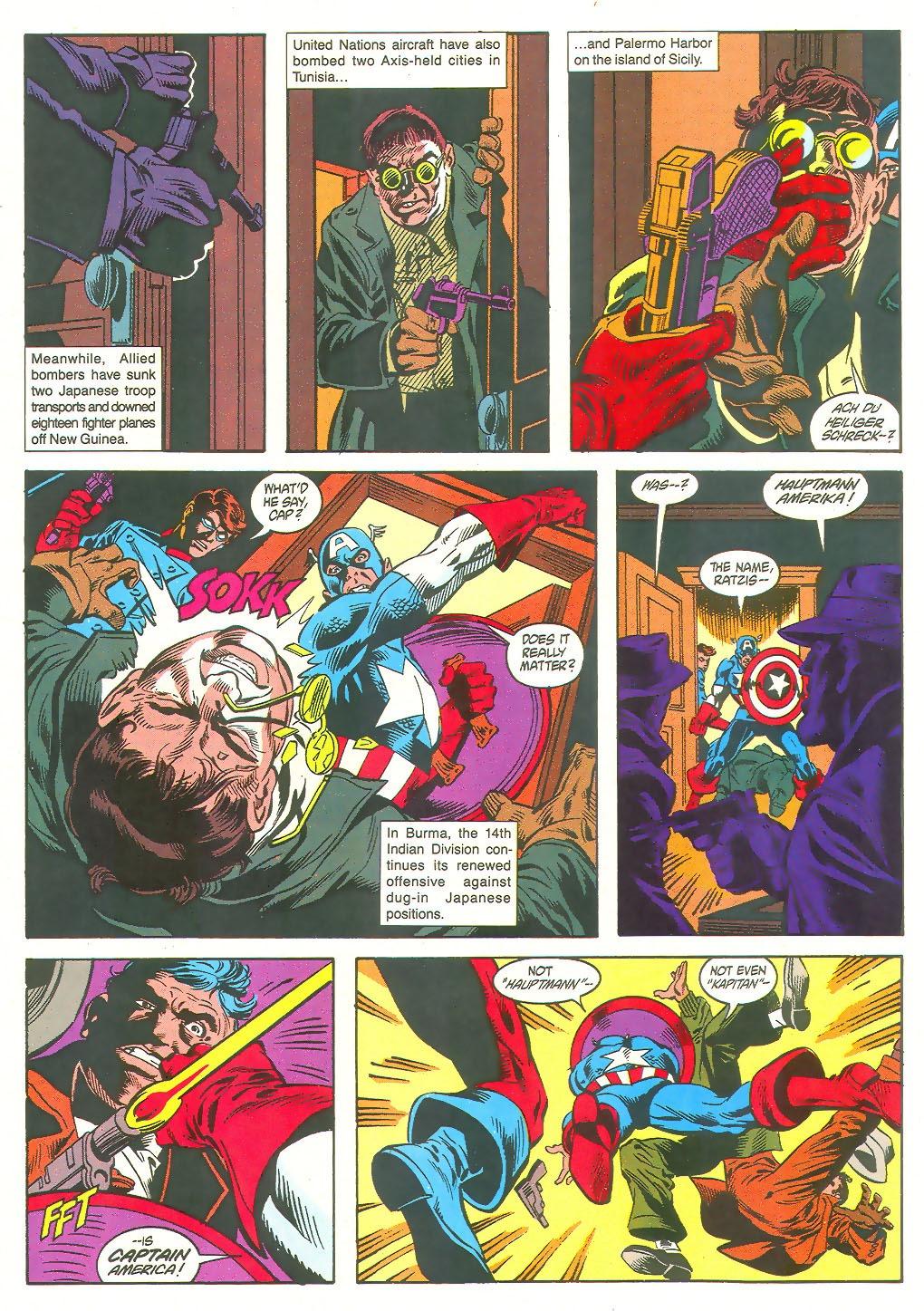
The problem here is the art. Specifically, the color art. The line art and inks are fine. They're nothing spectacular, but they tell the story nicely and there are even a few places here and there that elevate up into "really good" territory. But those colors. Garish, sloppy, and distracting would be the best way to describe them. The colors on this comic take what SHOULD be a pretty good Captain America throwback story down a couple of notches. . .they're THAT bad.
Who knew Cap's shield was pink inside. . .
Overall, this one is a bit of a mixed bag for me. I like the story and the art, but the colors are so God-Awful distracting that they really take away from the enjoyment of this comic. Maybe it was done on purpose to try and further evoke the Bronze Age throwback feel of the story? I'm not sure, but it's pretty disappointing. Still, I see this one in the bargain bins all the time, so pick it up if you're looking for some Nazi-Punchin' Captain America on the cheap and can stand some bad coloring.
NEXT!
DAREDEVIL & CAPTAIN AMERICA:
DEAD ON ARRIVAL
Marvel (2008)
SCRIPTS: Tito Faraci
PENCILS: Claudio Villa
COVER: Claudio Villa
And so we come to the first one shot of the bunch NOT to be set in WWII. It's a team-up with Daredevil against a villain from the past who has seemingly come back to life, written and illustrated by two top Italian comic creators. Let's do it!
First, the cover.
I'm kind of a sucker for covers like this where the characters are set against a stark background. Daredevil and Captain America are very nicely showcased and detailed in a darkly-inked and realistic way that reminds me a lot of one of my all-time favorite comic artists, Steve Epting. It's not the greatest comic cover I've seen, but it definitely will take a turn up on my office wall's rotating comic cover display one of these days. Moving along. . .
The story goes like this:
It all starts as a normal, kind of boring night for Captain America and Daredevil. . .Cap punching training robots at Avengers HQ in his spare time, because spare time to Captain America is wasted time, and DD punching lowlifes in the alleys of Hell's Kitchen, as Daredevil tends to do.
BUT THEN. . .Nick Fury shows up and tells Cap that he's on the job. A villain called Death-Stalker, thought long dead after a battle with Daredevil gone wrong, seems to have returned. The problem is that the gloves he wears control his ability to shift back and forth to another plane of reality. . .and there's a set of the exact same gloves at S.H.I.E.L.D. HQ that have just activated, which should be impossible. S.H.I.E.L.D. scientists are worried that the paradox will tear open a hole that will destroy their entire reality. Not good. Luckily, they can track the energy given off by the gloves and that's where Cap comes in.
AT THE SAME TIME. . .Daredevil is told that there's a murder witness at police HQ that will only talk to him. She's there to deliver a message to DD. . .Death-Stalker is back and has a bunch of hostages at the cemetery where he "died" many years before. If DD doesn't show up, the hostages die. And so off he goes!
WHILE THAT'S GOING ON. . .we learn through flashbacks that the Death-Stalker that has seemingly come back to life is ACTUALLY the original Death-Stalker, who has somehow managed to travel forward in time thanks to a failed (?) experiment that was supposed to help keep Death-Stalker in one reality instead of shifting back and forth the way he does. When he arrives in the future and finds out DD accidentally killed him, he goes just a little crazy and concocts the hostage plan in order to take revenge for his own death.
AND SO. . .Daredevil shows up in the cemetery to deal out some well-deserved villain punching. During the fight, Death-Stalker sprays DD in the face with a chemical that makes him see living things as monsters. . .JUST in time for Captain America to arrive, thanks to the S.H.I.E.L.D. tracking device. Daredevil sees Cap as a monster and it's time for a "Heroes fight each other for the wrong reasons" battle!
BUT. . .Cap stabs DD with a syringe and gives him a dose of anti-hallucinigenic ex-machina that brings him back to reality and suddenly it's time for a villain punchin' TEAMUP! Together, Captain America and Daredevil pretty easily beat Death-Stalker, but he tries to have the last laugh by killing himself with his own dimension-shifting gloves and destroying reality. . .unfortunately, both S.H.I.E.L.D. and Death-Stalker were wrong and nothing is destroyed. Death-Stalker returns to his own time and everyone wonders what the hell just happened.
The End.
Well then. Hmmmmm. . .not bad. Not great, mind you, but a pretty good story. It's a simple and timeworn framework of "two heroes collide while both hunting the same villain" that's been a mainstay of superhero comics since there WERE superhero comics. But even though the plot is a moldy oldie, that doesn't make it bad. . .just a little overly-familiar. The dialogue is well-written and the story moves along at a brisk pace. It's a classic sort of story that fits like a favorite pair of old jeans. Every now and then, that's just fine.
The art on this one really elevates it up beyond the familiar premise. Like I said when I took a look at the cover. . .it's the sort of realistic, darkly-inked artwork that really brings characters to life. It reminds me a lot of the style of the artist that made me love Captain America again. . .Steve Epting. It might be unfair to compare one artist to another, but the similarities in style are very strong. But like I said, it's a style I really like a lot, so I'm not complaining. Just about any comic artist can illustrate heroes in battle poses. It takes a GOOD comic artist to make the scenes of people standing around talking just as interesting. The artist on this one delivers and makes an okay story stand out in a great way.
Overall, this was a pretty good comic. It has an extremely timeworn premise, but is well-written and backed up by some great art. Definitely one to pick up if you spot it in the bargain bin.
NEXT!
GHOST RIDER / CAPTAIN AMERICA:
FEAR
Marvel (1992)
SCRIPTS: Howard Mackie
PENCILS: Lee Weeks
COVER: Lee Weeks
In this one shot, Captain America teams up with Ghost Rider. . .the 90's version. . .Danny Ketch, my personal favorite Ghost Rider. They will have to overcome their own darkest fears in order to defeat Marvel's (copycat) Scarecrow. Two of my favorite characters together. . .Let's do it!
First, the cover.
Ehhhh. . .it's okay. It's got all the major players. They're drawn nicely. . .especially Ghost Rider. I like the bold colors quite a bit. There's just something missing and I'm not exactly sure what it is. Maybe it just looks too posed. It's hard to say. Sometimes a cover can be well done and STILL seem just sort of okay. To me, this is one of those covers. Moving along. . .
The story goes like this:
We open in a mysterious operating room, where an unknown man is undergoing some obviously illegal surgery. He wakes up while still under anesthesia and slaughters the doctors. It is revealed that he's Marvel's Scarecrow.
A WEEK LATER. . .Ghost Rider (AKA Danny Ketch) shows up on the scene of a hostage situation, but Police Captain Dolan is more concerned with taking him down than the safety of the hostages. Afterward, Danny gets into an argument with his girlfriend, Stacy (Captain Dolan's daughter and also a police officer, who isn't aware that her boyfriend is the host of the Spirit of Vengeance) over whether or not Ghost Rider is a hero or menace. Danny feels he's doing the right thing, but is having a bit of a crisis of conscience. . .
THAT NIGHT. . .Scarecrow is in the city and leaving "messages" for Captain America in the form of dead bodies. He is interrupted while killing a young couple by two police officers, one of which (By remarkable coincidence!) is Danny Ketch's girlfriend, Stacy Dolan. Scarecrow kills her partner, but takes Stacy prisoner because of a strong resemblance to his mother. . .
IN THE MEANTIME. . .Captain America shows up on the scene of Scarecrow's latest "Message" to him and fills Captain Dolan in on Scarecrow's past, as well as his obsession with Cap. At the same time, Ghost Rider shows up and Captain America holds the police back in order to go speak to him.
Surprisingly, a stock "heroes battle until they realize they're on the same side" comic battle doesn't ensue! Instead, Cap calmly confronts Ghost Rider and tells him that he knows GR isn't the villain and that Cap himself has been called the villain enough times to give him the benefit of the doubt. Ghost Rider appreciates that Cap didn't just jump in on him and fills him in on the situation. The two heroes team up to take down Scarecrow and rescue Stacy.
WHILE THAT'S GOING ON. . .Stacy Dolan is being tortured by Scarecrow, who is calling her "mommy", AND mysterious figures are following Scarecrow's trail, remarking on the new powers they've built into him and how they need to get to him first so they can make use of their new "investment".
AND SO. . .Captain America and Ghost Rider track Scarecrow down pretty easily . . .by following a giant flock of birds congregating around a particular building in Brooklyn. Cap comes up with a plan: Cap going straight in and using Scarecrow's obsession with him in order to let Ghost Rider come in from above and save Stacy. Unfortunately, Ghost Rider isn't much one for strategy, so as soon as Cap and Scarecrow start fighting, GR jumps right in.
They both learn pretty quickly that Scarecrow has been upgraded since last time he and Cap squared off. . .he now has super-strength AND a sort of "fear field" emanating from him that drastically weakens Cap. It affects Ghost Rider less, so while he keeps fighting Scarecrow, Cap takes a minute to recover. . .just in time for Captain Dolan to roll up, determined to rescue his daughter.
IN THE MEANTIME. . .the battle between GR and Scarecrow moves from the roof inside while Cap and Dolan come into things from below, discovering a series of brutally-murdered corpses along the way, which drives Dolan into a frenzy. When they all come together in the room where Stacy hangs, bloody and tortured, Cap has to keep both Dolan and Ghost Rider from killing Scarecrow.
IN THE END. . .After they free Stacy, she grabs a gun in order to kill Scarecrow. He tries to escape, but falls out of the window, impaling himself on the fence below.
EPILOGUE: Captain America convinces Captain Dolan to soften his hard-line approach to Ghost Rider. Thanks to Cap's encouragement, Danny Ketch is more convinced than ever that he's a hero. And finally, we learn that an accelerated healing factor is another of Scarecrow's new improvements as he comes back to life just in time for a mysterious fellow named Stern to help him escape, letting him know that he's behind Scarecrow's new powers and that he has some things for him to do. . .
The End.
Allrighty then. Not too bad.
Like the Captain America/Daredevil team up, it's REALLY more of a Ghost Rider story (Early in GR's career. This story references GR #25) than a Captain America story. . .and (like that story) it also follows the well-worn comic path of "Two heroes accidentally meet up while on the same case".
What I DID like a lot about this story was that the initial meeting between Cap and GR DIDN'T start off as a cliche "Heroes fight until they realize they're on the same side", but was actually a really good character moment of Captain America letting Ghost Rider know that HE'S been labeled the villain from time to time and that he's willing to give GR a chance. I found the calm conversation between a veteran hero and new hero to be be refreshing and really sort of surprising. It's pretty much the best part of this story!

The rest of it. . .it's okay. Like I said, it follows a VERY well-worn track, and even given the great character moment of Cap encouraging a new hero instead of just jumping into a fight, Captain America plays a pretty weak role here. He could have been replaced with literally almost any other veteran superhero. This would have been a great vehicle for an inter-company Ghost Rider/ Batman crossover with exactly the same story beats. Daredevil would fit easily. . .even Iron Fist. Since this is so much more a Ghost Rider story, the second character team up slot is SO generic that. . .really, beyond a few interactions, it's not even needed. This COULD have easily just been a Ghost Rider solo story.
ALSO like the Captain America/Daredevil team up, it's the art that elevates this one-shot beyond the threadbare premise and a story that's mostly an extended fight scene. Lee Weeks is a very solid comic artist with a kinetic, realistic style and with Al Williamson's bold inks, the art team channels their inner David Mazzucchelli for a dark, gritty, realistic take on these characters and the filthy city the story takes place in. The coloring is a little garish, but for some reason it works here. . .making the dark artwork even darker in a good way.

SO. . .what we have here is a decent story backed up by some excellent artwork that follows an extremely well-worn comic book team up path with a little twist. After that, it's mostly fighting. The team-up aspect of the story is extremely generic to the point that Captain America is interchangeable with almost any other veteran superhero. All in all, it's a pretty good Ghost Rider story worth picking up if you should spot it in the bargain bin.
NEXT!
WHAT IF: CAPTAIN AMERICA
WHAT IF. . .CAPTAIN AMERICA FOUGHT IN THE CIVIL WAR?
Marvel (2006)
SCRIPTS: Tony Bedard
PENCILS: Carmine DiGiandomenico
COVER: Tony Harris
And last but (hopefully) not least, we have a What If? story featuring Captain America in the Civil War! Let's just make it clear here. . . I LOVE What If?/Elseworlds stories! But here's the problem with them. . .they either work or they don't. There's very little wiggle room between Good and Bad when it comes to What If?/Elseworlds stories, in my humble opinion. Let's see which side of the line this one comes in on!
But first, the cover.
Tony Harris is a great artist, in my opinion, and he does a solid job on this cover. . .unfortunately, right out of the gate I'm getting the feeling this What If? MIGHT not hit the "good" side of the line just from the subject matter. I'm going to give it a fair shake, but seeing Captain America in this strange quasi-Native American getup doesn't give me much confidence. Cap's uniform is pretty nice, but that headdress/mask combo just seems to be trying a bit too hard. That said, the cover itself is fine. I like the strong use of Red, White, and Blue colors a lot. Moving along. . .
The Story goes like this:
1863. . .the Kansas/Missouri border during the Civil War on a world like ours, but just a little different. Fresh recruit Corporal Steve Rogers joins the "Redlegs" Regiment under the command of Colonel Buck Barnes. . .an elite cavalry unit formed to harass Confederate Guerrilla units and the towns that support them.
Roger's naive notions of fighting for an honorable cause are shattered during his first raid with the Redlegs, where his fellow soldiers kill women and children while looting and ravaging a small town. Barnes confronts Rogers when he tries to protect 3 small children he finds hiding in a barn. Rogers turns against his commander when Barnes orders him to kill them. The fight ends with Rogers being shot in the back by Barnes and dragged by horses out of town.
LATER. . .Rogers is found and rescued by Private Wilson, a member of the all-volunteer African and Native American Third Indian Home Guard, who takes him to their base at Fort Gibson to recover from his wounds. The fort's commander is convinced that Rogers won't last the night. Wilson believes that he was guided to Rogers by an Eagle Spirit for a reason, and stays with him through the night, tending to his wounds as taught to him by the Medicine Man who raised him.
BUT. . .Barnes and the Redlegs have tracked Rogers to Fort Gibson, and late that night they show up, demanding Rogers be handed over for execution as a deserter and traitor. While Barnes and the fort's commander are arguing, Wilson performs a Medicine ceremony to summon the Eagle spirit and heal Rogers by bringing out his inner strength. But instead of just healing Rogers, he is possessed by the Eagle Spirit and transformed into a mighty warrior!
Barnes sees the strange lights coming from the cabin where the ceremony is taking place and breaks down the door. The same ceremony that drew out Roger's inner strength also draws out what is inside of Barnes. . .turning him into a twisted figure of hate with a skull for a face!
Driven mad by his sudden transformation, Barnes orders his men to slaughter everyone in the fort. Rogers jumps in to stop the massacre and a battle between the new Captain. . .er. . .Corporal? America and White Skull ensues. Through his new powers of command over a spirit eagle, Rogers easily defeats Barnes.
EPILOGUE. . .Corporal Rogers is promoted to Captain (so, Captain America) and helps end the Civil War earlier than in our history. He also prevents the assassination of President Lincoln, and ended the Indian Wars before they began. White Skull escaped captivity and formed a white supremacist organization that still exists and is the enemy of Steve Roger's future ancestor. . .his great grandson, General America!
The End.
Sigh. This one falls on the wrong side of the Good/Bad line for What If? and Elseworlds stories. I REALLY wanted to like this one. The idea sounded great! Captain America in the Civil War? I say, "HELL YEAH!" Unfortunately, it's more of a "Why?"
The beginning of the story is pretty good and gives a solid background for the Civil War version of Steve Rogers. . .experiencing the true horror of war and seeing the injustice on both sides of the conflict as being one and the same. It's a good reason for Captain America to come into existence.
Sadly, the actual execution of HOW Captain America (and by extension, White Skull) came to be just seems forced, rushed, and frankly a bit silly. To be honest, after the first half of this story, the whole thing seems forced and rushed. . .like the writer was trying to cram too many Captain America story beats into what little page space he had left, and in doing so, did it in a way that everything happens just because it does. Case in point: Captain America in regular comics wears a mask because he's sort of a celebrity and wants to be able to live a normal life. . .but why does THIS Captain America wear a mask when he suddenly transforms? He just does. That's just one example. There's a lot of others.
And so we come to one of the biggest problems with Elseworlds-style stories. . .the writer has a very limited space in which to build an (almost) entirely new world. Sometimes it works, sometimes it doesn't. This is one of those times it doesn't.
As far as the art goes. . .It's pretty good. I happen to be a fan of Carmine DiGiandomenico's unique art style, but it's definitely one of those "Love it or Hate it" styles. Truthfully, this isn't his best work, and his style doesn't really fit the tone of the story, but it's not bad. It's just sort of a shame that he got saddled with illustrating such a weak story.
Overall, what we have here is a story with a good start that fails in execution about halfway through, feeling rushed and with story elements forced in for no reason other than as nods to "normal" Captain America when the writer should have concentrated on making his own creation special. The art has a unique style and isn't bad, but doesn't really fit the story. All in all, I have to sadly suggest skipping this one entirely unless you are a Captain America or What If? Completionist.
And there we are, folks! A little more of a mixed bag than the first handful of Captain America one shots, but really only one that could be called bad. I'd say that one bad out of eight is pretty good for any handful of comics, so overall this has been a decent batch of Longbox Junk.
Up Next. . .
How about something a little different?
I feel like taking a request. Any suggestions?
Tell me what Longbox Junk you want me to check out!